April 29, 2015

Charles Darwin

Green Army: Persons of Interest


Aristotle (384 – 22 BCE):
[Empedocles (493 – 33 BCE) conjectured that certain] animals survived [because] their chance constitution made them suitable for survival.
[Whereas, other animals] were differently constituted and so were destroyed …
(Physics, Book II: 8)

Erasmus Darwin (1731 – 1802):
As the earth and ocean were probably peopled with vegetable productions long before the existence of animals; and many families of these animals long before other families of them, shall we conjecture that one and the same kind of living filaments is, and has been, the cause of all organic life? …

Would it be too bold to imagine that, in the great length of time since the earth began to exist, perhaps millions of ages before the commencement of the history of mankind … that all warm-blooded animals have arisen from one living filament … possessing the faculty:
  • of continuing to improve by its own inherent activity, and
  • of delivering down these improvements by generation to its posterity …
(Zoönomia, Vol 1, 1794)

William Greg (1809 – 81) [Essayist]:
The careless, squalid, unaspiring Irishman multiplies like rabbits …
[Whereas:] the frugal, foreseeing, self-respecting, ambitious Scot, stern in his morality, spiritual in his faith, sagacious and disciplined in his intelligence, passes his best years in struggle and in celibacy, marries late, and leaves few behind him.
Given a land originally peopled by a thousand Saxons and a thousand Celts — and in a dozen generations five-sixths of the population would be Celts, but five-sixths of the property, of the power, of the intellect, would belong to the one-sixth of Saxons that remained.
In the eternal 'struggle for existence,' it would be the inferior and less favoured race that had prevailed — and prevailed by virtue not of its good qualities but of its faults.
(Charles Darwin, The Descent of Man, Chapter 5, 1871)

Elizabeth Stanton (1815 – 1902):
The real difficulty in woman's case is that the whole foundation of the Christian religion rests on her temptation and man's fall, hence the necessity of a Redeemer and a plan of salvation.
As the chief cause of this dire calamity, woman's degradation and subordination were made a necessity.
If, however, we accept the Darwinian theory, that the race has been a gradual growth from the lower to a higher form of life, and that the story of the fall is a myth, we can exonerate the snake, emancipate the woman, and reconstruct a more rational religion for the nineteenth century, and thus escape all the perplexities of the Jewish mythology as of no more importance than those of the Greek, Persian and Egyptian.
(The Woman's Bible, Part II, Comments on the Old and New Testaments from Joshua to Revelation, New York, 1898)

Blanche Z de Baralt:
Women must consider themselves the main agents for the continuity and evolution of the race towards a higher physical, intellectual and spiritual level. …
Education of girls and young women must prepare them for this great mission.
Upon reaching marital age they must have such an elevated and clear notion about it that they should refuse to wed men with inferior physical, intellectual and moral conditions.
(24 December 1911)

Leo Tolstoy (1828 – 1910):
[My children, the] views you have acquired about Darwinism, evolution and the struggle for existence won't explain to you the meaning of your life and won't give you guidance in your actions, and a life without an explanation of its meaning and importance, and without the unfailing guidance that stems from it is a pitiful existence.
(1 November 1910)

Tom DeLay (1947) [Republican House Majority Leader, 2003–05]:
[The Columbine High School massacre occurred] because our school systems teach our children that they are nothing but glorified apes who have evolutionised out of some primordial mud.
(Quoted by Peter Singer, The President of Good and Evil, 2004, p 131)

Charles Darwin (1809 – 82):
As man advances in civilization, and small tribes are united into larger communities, the simplest reason would tell each individual that he ought to extend his social instincts and sympathies to all members of the same nation, though personally unknown to him.
This point being once reached, there is only an artificial barrier to prevent his sympathies extending to the men of all nations and races.
(The Descent of Man, 1871)

The state of mind which grand scenes formerly excited in me, and which was intimately connected with a belief in God, did not essentially differ from that which is often called the sense of sublimity; and however difficult it may be to explain the genesis of this sense, it can hardly be advanced as an argument for the existence of God, any more than the powerful though vague and similar feelings excited by music. …

[The] extreme difficulty or rather impossibility of conceiving this immense and wonderful universe … as the result of blind chance or necessity [compels one] to look to a First Cause having an intelligent mind in some degree analogous to that of man …
This conclusion, [once] strong in my mind [has since,] very gradually [and] with many fluctuations, become weaker.
[Can] the mind of man, which has been developed from a mind as low as that possessed by the lowest animals, be trusted when it draws such grand conclusions? …

The mystery of the beginning of all things is insoluble by us; and I, for one, must be content to remain an Agnostic.
(Autobiography, 1876)


Charles Darwin (1809 – 82)


Journal of Researches (1835)


Considering the small size of [the Galapagos] islands, we feel the more astonished at the number of their aboriginal beings, and at their confined range.
Seeing every height crowned with its crater, and the boundaries of most of the lava-streams still distinct, we are led to believe that within a period, geologically recent, the unbroken ocean was here spread out.
Hence, both in space and time, we seem to be brought somewhat near to that great fact — that mystery of mysteries — the first appearance of new beings on this earth.
(p 44)


The Descent of Man (1871)


[Ignorance] more frequently begets confidence than does knowledge …
[It] is those who know little, and not those who know much, who so positively assert that this or that problem will never be solved by science.
(p 234)

During [the Dark Ages] the Holy Inquisition selected with extreme care the freest and boldest men in order to burn or imprison them.
In Spain alone some of the best men — those who doubted and questioned, and without doubting there can be no progress — were eliminated during three centuries at the rate of a thousand a year.
The evil which the Catholic Church has thus effected, though no doubt counterbalanced to a certain, perhaps large extent in other ways, is incalculable …
(p 269)


Recollections of the Development of My Mind and Character (1876)


Religious Belief

[Between 1836 to 1839 I gradually came] to see that the Old Testament, from its manifestly false history of the world, with the Tower of Babel, the rainbow as a sign &c &c, & from its attributing to God the feelings of a revengeful tyrant, was no more to be trusted than the sacred books of the Hindoos, or the beliefs of any barbarian.
(p 391)

By further reflecting
  • that the clearest evidence would be requisite to make any sane man believe in the miracles by which Christianity is supported,
  • that the more we know of the fixed laws of nature the more incredible do miracles become,
  • that the men at that time were ignorant & credulous to a degree almost incomprehensible by us,
  • that the Gospels can not be proved to have been written simultaneously with the events,
  • that they differ in many important details, far too important as it seemed to me to be admitted as the usual inaccuracies of eye-witnesses
— by such reflections as these … I gradually came to disbelieve in Christianity as a divine revelation.

[I was at first] very unwilling to give up my belief.
But I found it more & more difficult … to invent evidence which would suffice to convince me.
Thus disbelief crept over me at a very slow rate, but was at last complete.
The rate was so slow that I felt no distress, & have never since doubted even for a single second that my conclusion was Correct.

I can indeed hardly see how anyone ought to wish Christianity to be true; for if so, the plain language of the text seems to show that the men who do not believe, & this would include my Father, Brother & almost all my best friends, will be everlastingly punished.
And this is a damnable doctrine.
(p 392)

The old argument from design in nature, as given by Paley, which formerly seemed to me so conclusive, fails now that the law of natural selection has been discovered. …
There seems to be no more design in the variability of organic beings & in the action of natural selection, than in the course which the wind blows.
Everything in nature is the result of fixed laws.
(p 393)

That there is much suffering in the world no one disputes.
Some have attempted to explain this … by imagining that it serves for … moral improvement.
But the number of men in the world is as nothing compared with that of all other sentient beings, & these often suffer greatly without any moral improvement.
[What] advantage can there be in the sufferings of millions of the lower animals throughout almost endless time? …

At the present day the most usual argument for the existence of an intelligent God is drawn from deep inward conviction & feelings which are experienced by most persons. …
This argument would be a valid one, if all men of all races had the same inward conviction of the existence of one God; but we know that this is very far from being the case.
Therefore I cannot see that such inward convictions & feelings are of any weight as evidence of what really exists.
(p 394-5)

A man who has no assured & ever present belief in the existence of a personal God or of a future existence with retribution & reward, can have for his rule of life, as far as I can see, only to follow those impulses & instincts which are the strongest or which seem to him the best ones. …
[And, if] he acts for the good of others, he will receive the approbation of his fellow-men & gain the love of those with whom he lives; & this latter gain undoubtedly is the highest pleasure this earth. …
As for myself I believe that I have acted rightly in steadily following & devoting my life to science.
(p 396)

(Charles Darwin: Evolutionary Writings, 2008)

April 25, 2015

Adaptation and Mitigation

IPCC Climate Change 2014


Many adaptation and mitigation options can help address climate change, but no single option is sufficient by itself.
Effective implementation depends on policies and cooperation at all scales, and can be enhanced through integrated responses that link mitigation and adaptation with other societal objectives.
(p 46)

The costs of achieving nearly universal access to electricity and clean fuels for cooking and heating [across the developing world] are projected to be between USD 72 to 95 billion per year until 2030 with minimal effects on GHG emissions (limited evidence, medium agreement) and multiple benefits in health and air pollutant reduction (high confidence).
(p 56)

Adaptation options for coral reef systems are generally limited to reducing other stressors, mainly by enhancing water quality and limiting pressures from tourism and fishing, but their efficacy will be severely reduced as thermal stress and ocean acidification increase.
(AR5 Synthesis Report — Longer Report, 2014, p 48)

March 27, 2015

George Megalogenis

Green Army: Persons of Interest


Robert Manne (1947):
[In the late 90's Les Murray (1938) composed] a poem about Pauline Hanson …
I've seen her tremble
I've seen her whisper
I've felt her power
Burning before me …
(Sorry Business, The Monthly, March 2008)

Geoffrey Wright (1959):
This is not your country.
(Romper Stomper, 1992)

Pauline Hanson (1954):
One People, One Nation, One Flag!
(Maiden Speech, Australian House of Representatives, 10 September 1996)

1930s Political Slogan:
Ein Volk, ein Reich, ein Führer!
[One People, One Empire, One Leader!]

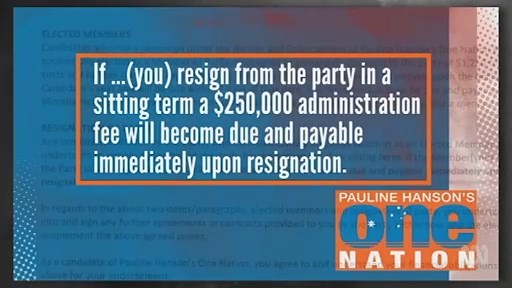
Pauline Hanson's One Nation:
We will bring back federalism and restore Australia’s constitution so that our economy is run for the benefit of Australians instead of the UN and unaccountable foreign bodies that have interfered and have choked our economy since the federal government handed power to the International Monetary Fund in 1944. …
We need to exit the UN.
(Economics & Tax Policy, Accessed 26 June 2017)


(Please Explain, Four Corners, ABC Television, 3 April 2017)


Pauline Hanson (1954)


Pauline Hanson's One Nation Senator for Queensland (2014)

Our common oppressors are a class of raceless, placeless, cosmopolitan elites who are exercising almost absolute power over us: like black spiders above the wheels of industry, they are spinning the webs of our destiny.
(Pauline Hanson and George Merritt, Pauline Hanson — The Truth: On Asian Immigration, the Aboriginal Question, the Gun Debate and the Future of Australia, Saint George Publishing, 1997, p 155)

[I want] multiculturalism abolished. …
A truly multicultural country can never be strong or united. …
[At] this stage that I do not consider those people from ethnic backgrounds currently living in Australia anything but first-class citizens, provided of course that they give this country their full, undivided loyalty. …

I am fed up to the back teeth with the inequalities that are being promoted by the government and paid for by the taxpayer under the assumption that Aboriginals are the most disadvantaged people in Australia. …

The Family Law Act … should be repealed. …

The government should cease all foreign aid immediately …

Between 1984 and 1995, 40% of all migrants coming into this country were of Asian origin.
I believe we are in danger of being swamped by Asians. …
They have their own culture and religion, form ghettos and do not assimilate.

(Maiden Speech, Australian House of Representatives, 10 September 1996)


Now we are in danger of being swamped by Muslims, who bear a culture and ideology that is incompatible with our own.

(Maiden Speech, Australian Senate, 14 September 2016)


John Howard (1939)


25th Prime Minister of Australia (1996 – 2007)

One of the great changes that has come over Australia in the last six months is that people do feel able to speak a little more freely and a little more openly about what they feel.
In a sense the pall of censorship on certain issues has been lifted …
I think there has been a change and I think that's a very good thing.
(Queensland Liberal State Council, 22 September 1996)

By the year 2000, I would like to see an Australian nation that feels comfortable and relaxed about three things:
  • I would like to see them comfortable and relaxed about their history;
  • I would like to see them comfortable and relaxed about the present; and
  • I'd also like to see them comfortable and relaxed about the future.
(Four Corners 55th Anniversary — 1990s, ABC Television, 2016)

… I have to live with the consequences of [the positions I've taken as prime minister,] both now, and into the future.
And, if I ever develop reservations … I hope I would have the grace to keep them to keep them to myself …
(David Marr, His Master's Voice, Quarterly Essay, Issue 26, 2007, p 3)


David Marr (1947)


John Howard [attacked] "black armband" historians and resolutely refused to apologise to the Stolen Generations.
He would stage the Intervention in the Northern Territory as a curtain-raiser for the 2007 election.
This was race politics played by a master.
(The White Queen, Issue 65, March 2017, p 67)

… Howard's government has been the most unscrupulous corrupter of public debate in Australia since the Cold War's worst days back in the 1950s. …
He has a genius for ambiguity [that,] most of the time, keeps [him] just this side of deceit.
But he also lies without shame. …
[He] can admit error, but it is extremely rare.
Apologies are almost unknown.
(p 4)

[Under] Howard, the press has found itself misled, intimidated and starved of information.
On coming to power, Howard set about making sure the tactics he had used so brilliantly to claw down his rivals would not be turned against his government.
There would be minimal tolerance for dissent within the party, the government and the bureaucracy.
The great leaker would stop the leaks.
Senior bureaucrats who survived the purge of the first weeks were instructed to report all calls by journalists to die Prime Minister's press office.
(p 29)

Stories were doled out as rewards.
More than ever under Howard, the press would win access through favourable coverage.
The new communications minister, Richard Alston, was soon lashing the ABC over budgets and bias.
Journalists were locked out of stories - particularly those involving the military and refugees
(p 30)

Canberra has a taste for punishing dissent by cutting off funds.
The Voltaireans of the Cabinet may be willing to sacrifice their lives for the sake of free speech in Australia, but they don't like paying for it. …
Clive Hamilton & Sarah Maddison:
In Australia, recent years have seen an unprecedented attack upon NGOs, most particularly upon those organisations that disagree with the current federal government's views and values.
The attacks have come both from government itself and from close allies such as the Institute of Public Affairs.
Questions have been raised about NGOs' representativeness, their accountability, their financing, their charitable status and their standing as policy advocates in a liberal democracy such as Australia.
(Silencing Dissent, Allen & Unwin, 2007, p 82)
(p 51)

(His Master's Voice, Quarterly Essay, Issue 26, Black Inc, 2007)


George Megalogenis (1964)


Pauline Hanson's timing was immaculately destructive.
(p 279)

[John] Howard couldn't bring himself to declare his outright opposition to Hanson because he felt he was being bullied by the media. …
[Indeed, he] shared the concerns of her supporters about the pace of cultural change.
He didn't see them as racists.
Yet by refusing to put Hanson in her place, Howard created a monster.
(p 280)

[Howard] was the last on his side to stand up to Pauline Hanson.
(p 300)
Paul Keating (1944):
In a nation of immigrants, John Howard let the racism genie out of the bottle. …
[Events like] the Cronulla riot has in its antecedents the notion that somewhere in officialdom at the top of the country it's all right to think poorly of people who come from a different background to yourself.
This is, I think, a dreadful letdown for the country after it had succeeded so greatly in settling so many people from abroad, in perhaps the most successful multicultural experiment in the Western world.
(p 237)

For years [John Howard] had argued against Australia moving before anyone else in the region [to address climate change.]
[Suddenly, in the lead up to the 2007 election,] he wanted to go first …
John Howard (1939):
Australia will … lead internationally on climate change … in a way that builds support for global action to tackle this enormous global challenge. …
[Our's] will be a world-class emissions trading system, more comprehensive, more rigorously grounded in economics and with better governance than anything in Europe.
Implementing an emissions trading scheme and setting a long-term goal for reducing emissions will be the most momentous economic decisions Australia will take in the next decade.
This emissions trading system … needs to last the whole of the twenty-first century if Australia is to meet our global responsibilities and further build our economic prosperity. …
Significantly reducing emissions will mean higher costs for businesses and households, there is no escaping that and anyone who pretends to do otherwise is not a serious participant in this hugely important public policy debate. …
[If] we get this wrong it will do enormous damage to our economy, to jobs and to the economic wellbeing of ordinary Australians, especially low-income households.
(3 June 2007)
(p 319)

[In December 2009, Tony] Abbott repudiated the Coalition's own 2007 election platform …
In a way this was more brazen than the Senate obstruction in the 1970s.
Back then there was an element of principle involved — the Coalition didn't agree with the Whitlam Program.
Abbott was opposing for the sake of it.
No previous opposition had overturned a policy that both sides had agreed to at the previous election. …
Tony Abbott:
[The argument for action on climate change] is absolute crap.
However, the politics of this are tough for us.
80% of people believe climate change is a real and present danger.
(Pyrenees Advocate, October 2009)
(p 349)

Hawke and Howard are Australian triumphalists, who think there is nothing wrong with the nation as it is.
Keating and Fraser are Australian cosmopolitans, who see room for improvement.
(p 4)

The Australian Moment was thirty-five years in the making, starting with
  • the Whitlam government's tariff cut and the formal recognition of China in the early 70s;
  • the Fraser government's termination of the White Australia policy with the entry of the Vietnamese refugees in the second half of the 70s;
  • the Hawke-Keating government economic reforms between 1983 and 1996; and
  • the Howard government's consolidation of those reforms, and the super-charging of the immigration program after 2001.
(p 345)

(The Australian Moment, 2012)

March 6, 2015

Intergovernmental Panel on Climate Change

Green Army: Research and Development


Countries in the tropics and Southern Hemisphere subtropics are projected to experience the largest impacts on economic growth due to climate change should global warming increase from 1.5°C to 2°C (medium confidence).

Global Warming of 1.5°C SPM, 6 October 2018, p 12.


Climate Change 2014


Severe, Pervasive, and Irreversible Impacts


Climate change will amplify existing risks and create new risks for natural and human systems.
Risks are unevenly distributed and are generally greater for disadvantaged people and communities in countries at all levels of development.
Increasing magnitudes of warming increase the likelihood of severe, pervasive, and irreversible impacts for people, species and ecosystems.
Continued high emissions would lead to mostly negative impacts for biodiversity, ecosystem services, and economic development and amplify risks for livelihoods and for food and human security.
(p 24)


Observed Changes and Their Causes


Human influence on the climate system is clear, and recent anthropogenic emissions of greenhouse gases are the highest in history.
Recent climate changes have had widespread impacts on human and natural systems.
(p 5)


Observed Changes in the Climate System

Warming of the climate system is unequivocal, and since the 1950s, many of the observed changes are unprecedented over decades to millennia.
  • The atmosphere and ocean have warmed,
  • the amounts of snow and ice have diminished, and
  • sea level has risen.
(p 6)


Past and recent drivers of climate change

Anthropogenic greenhouse gas emissions have increased since the pre-industrial era driven largely by economic and population growth.
From 2000 to 2010 emissions were the highest in history.
Historical emissions have driven atmospheric concentrations of carbon dioxide, methane and nitrous oxide, to levels that are unprecedented in at least the last 800,000 years, leading to an uptake of energy by the climate system.
(p 9)

[Since 2000, the increased] use of coal relative to other energy sources has reversed the long-standing trend in gradual decarbonisation … of the world’s energy supply.
(p 11, emphasis added)


Attribution of climate changes and impacts

The evidence for human influence on the climate system has grown since AR4.
Human influence has been detected
  • in warming of the atmosphere and the ocean,
  • in changes in the global water cycle,
  • in reductions in snow and ice, and
  • in global mean sea-level rise …
[Human activity] is extremely likely to have been [the cause of more than half] of the observed warming since the mid-20th century.
In recent decades, changes in climate have caused impacts on natural and human systems on all continents and across the oceans.
Impacts are due to observed climate change, irrespective of its cause, indicating the sensitivity of natural and human systems to changing climate.
(p 12)


Extreme Events

Changes in many extreme weather and climate events have been observed since about 1950.
Some of these changes have been linked to human influences, including
  • a decrease in cold temperature extremes,
  • an increase in warm temperature extremes,
  • an increase in extreme high sea levels and
  • an increase in the number of heavy precipitation events in a number of regions.
(p 15)


Exposure and Vulnerability

The character and severity of impacts from climate change and extreme events emerge from risk that depends not only on climate-related hazards but also on exposure (people and assets at risk) and vulnerability (susceptibility to harm) of human and natural systems.
(p 16)


Human Responses To Climate Change: Adaptation and Mitigation

Adaptation and mitigation experience is accumulating across regions and scales, even while global anthropogenic GHG emissions have continued to increase.
(p 17)

(AR5 Synthesis Report — Longer Report, 1 November, 2014)