Showing posts with label Blue Army. Show all posts

November 21, 2023

Adam Smith

Blue Army: Persons of Interest


All for ourselves, and nothing for anyone else, seems, in every age, to have been the vile maxim of the Masters of Mankind.


Wherever there is a great property, there is great inequality.
For every rich man, you must have hundred poor.
And that rich man must live every time in fear because of the jealousy of others.
And if it is not for the firm hand of the magistrate … he would not be able to keep his capital safe. …
[Civil government,] in so far as it is instituted for the security of property, is in reality instituted for the defense
  • of the rich against the poor, or
  • of those who have some property against those who have none …

The Wealth of Nations, 1779.


Adam Smith (1723 – 90)


The Theory of Moral Sentiments (1759)


[The illusion that the accumulation of possessions brings real satisfaction is the] deception which rouses and keeps in continual motion the industry of mankind. …

The great source of both the misery and disorders and disorders of human life, seems to arise from over-rating the difference between one permanent situation and another …
Some of those situations may, no doubt, deserve to be preferred to others …
[But] none of them can deserve to be pursued with that passionate ardour which drives us
  • to violate the rules either:
    • of prudence, or
    • of justice; or
  • to corrupt the future tranquillity of our minds, either:
    • by shame from the remembrance of our own folly, or
    • by remorse from the horror of our own injustice.

An Inquiry into the Nature and Causes of The Wealth of Nations (1776)


According to the system of natural liberty, the sovereign has only three duties to attend to …
  • the duty of protecting the society from the violence and invasion of other independent societies; …
  • the duty of protecting, so far as possible, every member of the society from the injustice or oppression of every other member of it, or the duty of establishing an exact administration of justice, and …
  • the duty of erecting and maintaining certain public works and … institutions, which can never be for the interest of any individual, or small number of individuals to erect and maintain …

In spite of their natural selfishness and rapacity, [the rich] are led by an invisible hand to make nearly the same distribution of the necessities of life, which would have been made, had the earth been divided into equal portions among all its inhabitants, and thus, without intending it, without knowing it, advance the interest of society, and afford means to the multiplication of the species. …

It is not from the benevolence of the butcher, the brewer, or the baker, that we expect our dinner, but from their regard to their own interest.
We address ourselves, not to their humanity but to their self-love.

(Chapter 2, Book 1)


What are the common wages of labour, depends everywhere upon the contract usually made between those two parties, whose interests are by no means the same.
The workmen desire to get as much, the masters to give as little, as possible.
The former are disposed to combine in order to raise, the latter in order to lower, the wages of labour.

It is not, however, difficult to foresee which of the two parties must, upon all ordinary occasions, have the advantage in the dispute, and force the other into a compliance with their terms.
The masters, being fewer in number, can combine much more easily: and the law, besides, authorises, or at least does not prohibit, their combinations, while it prohibits those of the workmen.

We have no acts of parliament against combining to lower the price of work, but many against combining to raise it.
In all such disputes, the masters can hold out much longer.
A landlord, a farmer, a master manufacturer, or merchant, though they did not employ a single workman, could generally live a year or two upon the stocks, which they have already acquired.
Many workmen could not subsist a week, few could subsist a month, and scarce any a year, without employment. …

Masters are always and everywhere in a sort of tacit, but constant and uniform, combination, not to raise the wages of labour above their actual rate. …
Masters, too, sometimes enter into particular combinations to sink the wages of labour even below this rate.
These are always conducted with the utmost silence and secrecy till the moment of execution …

(Chapter 8, Book 1)


Our merchants and master manufacturers complain much of the bad effects of high wages in raising the price, and thereby lessening the sale of their goods, both at home and abroad.
They say nothing concerning the bad effects of high profits;
  • they are silent with regard to the pernicious effects of their own gains;
  • they complain only of those of other people.

(Chapter 9, Book 1)


No society can surely be flourishing and happy, of which the far greater part of the members are poor and miserable. …

Poverty, though it no doubt discourages, does not always prevent, marriage.
It seems even to be favourable to generation.
A half-starved Highland woman frequently bears more than twenty children, while a pampered fine lady is often incapable of bearing any, and is generally exhausted by two or three.
Barrenness, so frequent among women of fashion, is very rare among those of inferior station.
Luxury, in the fair sex, while it inflames, perhaps, the passion for enjoyment, seems always to weaken, and frequently to destroy altogether, the powers of generation. …

But poverty, though it does not prevent the generation, is extremely unfavourable to the rearing of children.
It is not uncommon, I have been frequently told, in the Highlands of Scotland, for a mother who has born twenty children not to have two alive. …
This great mortality, however will everywhere be found chiefly among the children of the common people, who cannot afford to tend them with the same care as those of better station.
Though their marriages are generally more fruitful than those of people of fashion, a smaller proportion of their children arrive at maturity. …

Every species of animals naturally multiplies in proportion to the means of their subsistence, and no species can ever multiply beyond it.
But in civilized society, it is only among the inferior ranks of people that the scantiness of subsistence can set limits to the further multiplication of the human species; and it can do so in no other way than by destroying a great part of the children which their fruitful marriages produce. …

The liberal reward of labour, by enabling them to provide better for their children, and consequently to bring up a greater number, naturally tends to widen and extend those limits.
It deserves to be remarked, too, that it necessarily does this as nearly as possible in the proportion which the demand for labour requires. …
It is in this manner that the demand for men, like that for any other commodity, necessarily regulates the production of men,
  • quickens it when it goes on too slowly, and
  • stops it when it advances too fast.
It is this demand which regulates and determines the state of propagation in all the different countries …

The liberal reward of labour, therefore, as it is the effect of increasing wealth, so it is the cause of increasing population.
To complain of it, is to lament over the necessary cause and effect of the greatest public prosperity.

(Chapter 10, Book 1)


The man whose whole life is spent in performing a few simple operations … generally becomes as stupid and ignorant as it it is possible for a human creature to become.
The torpor of his mind renders him not only incapable of relishing or bearing a part in any rational conversation, but of conceiving any generous, noble, or tender sentiment …
Of the great and extensive interests of his own country he is altogether incapable of judging …

(Part 2, Chapter 10, Book 1)


All for ourselves, and nothing for anyone else, seems, in every age, to have been the vile maxim of the Masters of Mankind.

(Chapter 4, Book 3)


The proposal of any new law or regulation of commerce which comes from [the business elite] ought always to be listened to with great precaution, and ought never to be adopted till after having been long and carefully examined, not only with the most scrupulous, but with the most suspicious attention.
[For it] comes from an order of men,
  • whose interest is never exactly the same with that of the public,
  • who have generally an interest to deceive and even to oppress the public, and
  • who accordingly have, upon many occasions, both deceived and oppressed it.

[The individual] is in this, as in many other cases, led by an invisible hand to promote an end which was no part of his intention. …
I have never known much good done by those who affected to trade for the public good.
It is an affectation, indeed, not very common among merchants, and very few words need be employed in dissuading them from it.

(Chapter 2, Book 4)


Wherever there is a great property, there is great inequality.
For every rich man, you must have hundred poor.
And that rich man must live every time in fear because of the jealousy of others.
And if it is not for the firm hand of the magistrate … he would not be able to keep his capital safe. …
[Civil government,] in so far as it is instituted for the security of property, is in reality instituted for the defense
  • of the rich against the poor, or
  • of those who have some property against those who have none …

The subjects of every state ought to contribute towards the support of the government, as nearly as possible, in proportion to their respective abilities; that is, in proportion to the revenue which they respectively enjoy under the protection of the state.

(Part 2, Chapter 2, Book 5)

July 4, 2021

Gigi Foster

Blue Army: Persons of Interest


An Epidemic of Socialism

COVID didn't crush the economy.
Government crushed the economy.


Kristi Noem (1971), Govenor of South Dakota, CPAC, 2021.


[You] need to control the virus to get people back to work.

Alan Kohler (1952)


(ABC News, 2 September 2020)


(ABC News, 7 December 2020)


Liberty Or Death

(Pandemic 2020)


Gigi Foster


Associate Professor of Economics, UNSW Business School.
PhD (Economics), University of Maryland.
BA (Ethics, Politics, and Economics), Yale University.


Are Lockdowns a Crime Against Humanity?


The Nuremberg code [is] a code of ethical standards …
It's something that, essentially, the war criminals of period during the WWII atrocities were facing, in the 1950s kind of period, to try to draw them to account for the massive damage they had done, the genocides.
And this code is something that requires governments defend the actions on the basis of public health.
So the sixth Nuremberg code demands that the decision maker must have a reasonable view that the benefits of an intervention will be higher than the costs, and failure to abide by that is a crime against humanity …
Museum Note:
On August 19, 1947, the judges of the American military tribunal in the case of the USA vs Karl Brandt et al … confronted the difficult question of medical experimentation on human beings. …
Although the [Nuremberg] code addressed the defense arguments in general remarkably none of the specific findings against Brandt and his codefendants mentioned the code.
Thus the legal force of the document was not well established.
The uncertain use of the code continued in the half century following the trial when it informed numerous international ethics statements but failed to find a place in either the American or German national law codes.
Nevertheless, it remains a landmark document on medical ethics …

Permissible Medical Experiments:
The degree of risk to be taken should never exceed that determined by the humanitarian importance of the problem to be solved by the experiment.
(Nuremberg Code, United States Holocaust Memorial Museum)
Have you seen a cost-benefit analysis produced by the government to defend its decisions during this period?
To strip people of their liberties.
To close schools.
To shut borders.
To cease trade.
I went for months waiting for that and finally produced one on the back of a cocktail napkin basically myself [in approximately … 15 hours in August 2020.]

[You can't assume] that it was those tough early restrictions that, as a package, created the outcomes we've seen.
My reading of the data is that pretty much how well or not you did in this period health-wise and economics-wise was kind of unrelated whether you locked down really hard or not so hard or whatever.
In fact the best thing to do probably would have been to target of our protection and our attention to the people who were actually vulnerable to this virus, and to invest in things like prophylactic treatments evaluation and evaluation of what can we do, medicines we can use, not just vaccines, but all sorts of cheaper things, when somebody gets the virus to prevent them getting serious symptoms. …

[We're] an island nation …
But there are many [other] reasons why the virus didn't run like it did, in the US for example, here that have nothing to do with our policy responses and you can compare Victoria to NSW if you want to get a sense of what's possible without locking down. …


[We] knew that this thing was killing mainly older people … which is why … in March of last year I called for the radical protection of older people, people in danger from this virus, and everybody else be allowed to go about their business as they deemed fit …
And the thing is, it's very uncomfortable right now to admit that we messed up.
For the politicians to admit it …

(Lockdowns and the path forward , ABC The Economists, 24 June 2021)


If you look at the people who have died from [COVID-19, they] have 5-6 years on average still to live …
How much does a developed society typically spend in normal times per [Quality Adjusted Life Year?]
Usually somewhere between $50,000 and $150,000 per QALY. …
Office of Best Practice Regulation:
Willingness to pay is the appropriate way to estimate the value of reductions in the risk of physical harm – known as the value of statistical life.
Based on international and Australian research a credible estimate of … the value of statistical life year is $195,000 in 2018 dollars.
(Best Practice Regulation Guidance Note: Value of statistical life, Department of the Prime Minister and Cabinet, Australian Government, October 2018)

William Viscusi (1947):
Unlimited personal freedoms will lower our well‐being, particularly when confronting crises for which collective, responsible behavior is desirable.

Mortality costs of COVID‐19 in Australia as of January 1, 2021
(Table A1 extract)
Number of deaths909
VSL ($ millions)8.6636
VSL × deaths ($ millions)7875
VSL = Value of a Statistical Life

(Economic lessons for COVID‐19 pandemic policies, South Economic Journal, 4 March 2021)
[So] every death we [prevent] from COVID-19 is [worth] around $500,000 and $600,000. …
Then you have a currency. …
Then you can say … when we do this lockdown:
  • [Firstly,] are we actually preventing that many more deaths?
  • [Secondly,] whatever number we are saving [we] multiply that by whatever the amount is we're willing to spend in normal times to save that amount of lives, that quality of life.
[Then] we get a dollar figure.
And then we can say: …
Is the economic cost of implementing these measures less than that?
  • [If] so — good idea.
  • If not — let's think about it more.
(Who'll pay the COVID-19 bill?, ABC The Signal, 5 May 2020)


What Have The Capitalists Ever Done For Us?


[Shutdowns are] very much a cure that's worse than the disease …
We had Trump saying that, by Easter, he wants things to be back on game …
He's right … to try to give a stopping point, to try to increase a bit of certainty about what to expect.
Because businesses … are in free freefall — people are stressed and they're going to be dying from that at some stage. …

This is the way that economies in communist systems organise …
[Whereas, Capitalism] has kept us all doing so well and having such luxurious lives, by historical and international comparisons, for so long. …

We know GDP is a huge predictor of [longevity.]
[Life] spans have increased over the last 100 years … on the back of rises in GDP per capita that pay for research and development, and health … and education services, and better roads, and everything that makes our lives better …
We giving that up with every day we are in shutdown …

[The global response to COVID-19] is actually killing people …
I'm talking about statistical lives lost.
Human welfare which is tanking because the economy is tanking. …

[Keeping the economy running] saves many more lives than are saved by quarantining the entire economy …
[The tradeoff is] not lives against money, it's lives against more lives. …

We need to be aggressively targeting isolation of older people, because those are the people who are dying. …
But to say to young people you should stay home and worry, and not go to pubs, is … absolutely a disgrace.
[These people] won't die from it — under 40 it's a 0.2% death rate …
[When Boris Johnson] could not stay that ["herd immunity"] course in the face public opinion — that was an entirely political move. …


The young people who lived through this, the coronavirus cohort, they are going to see negative effects throughout their lives because of what has already happened.
The longer this goes on, the worse off those people are going to be, 10 years, 20 years, 30 years …

I just want to see us open for business as soon as possible.

(As the coronavirus marches on, can wartime measures save us from a depression?, ABC The Economists, 26 March 2020)

October 11, 2019

Jordan Peterson

Blue Army: Persons of Interest


God the Father


Order, the known, appears symbolically associated with masculinity …
This is perhaps because the primary hierarchical structure of human society is masculine, as it is among most animals …
It is because men are, and throughout history have been,
  • the builders of towns and cities,
  • the engineers, stonemasons, bricklayers, and lumberjacks,
  • the operators of heavy machinery.
Order is:
  • God the Father, the eternal Judge, ledger-keeper and dispenser of rewards and punishments. …
  • the peacetime army of policemen and soldiers. …
Chaos, the eternal feminine, is … the crushing force of sexual selection.


Jordan Peterson (1962), 12 Rules for Life, 2018.


Fascists did not value masculinity per se – only that of some male members of the dominant race.
Socialists and communists (despite their own macho inclinations) were seen as the fomenters of ‘feminine’ indiscipline – while the fascist revolution was characterized by manly order.
The Nazis saw the Jews and Poles as ‘feminine’ races, achieving their goals through devious plots rather than masculine openness.


— Kevin Passmore (1962), Fascism: A Very Short Introduction, 2002.


[The] Western subjugation of the female is … a function of biblical thinking.

Joseph Campbell (1904 – 87), Love and the Goddess, The Power of Myth, Episode 5, 1988.


[Even] the most thoughtful and fair-minded of [men] fall back on conservative assumptions about the inevitability of present:
  • gender relations, and
  • distributions of power,
calling on precedent or sociobiology and psychobiology to demonstrate that male domination is natural and follows inevitably from evolutionary pressures.


Peggy McIntosh (1934), White Privilege and Male Privilege, 1988.


Biology is Destiny

Maybe it is more important to strengthen our characters than to repair the world.
So much of that reparation … is selfishness and intellectual pride masquerading as love, creating a world polluted with good works that don’t work. …

This idea — granted me by the grace of God — allowed me to believe that I could find what I most wanted …

All cultures … have, within their mythological history, certain constant features … just as all languages share grammatical structure …
  • The lines among which culture develops are determined biologically, and
  • the rules which govern that development are the consequence of the psychological expression of neurophysiological structures. …

Mythological renditions of history, like those in the Bible, are just as "true" as the standard Western empirical renditions, just as literally true, but how they are true is different.
  • Western historians describe (or think they describe) “what” happened.
  • The traditions of mythology and religion describe the significance of what happened …

I think I have discovered something that no one else has any idea about …


— The Divinity Of Interest, Maps of Meaning, 1999.


Look for your inspiration to the victorious lobster, with its 350 million years of practical wisdom.
Stand up straight, with your shoulders back.


Jordan Peterson (1962), 12 Rules for Life, 2018.


[The] fact that intuitive responses are widely held is not evidence that they are justified.
They are not rational insights into a realm of moral truth.
Some of them — roughly, those that we share with others of our species, irrespective of their cultural background — are responses that, for most of our evolutionary history, have been well suited to the survival and reproduction of beings like us.
Other intuitive responses — roughly, those that we do not share with humans from different cultures — we have because of our particular cultural history.
Neither the biological nor the cultural basis of our intuitive responses provides us with a sound reason for taking them as the basis of morality.


Peter Singer (1946), One World, Text, 2002, p 180.


Knowledge is about truth and falsehood
    — discovery, evidence, and reason.
Meaning is about storytelling
    — creativity, imagination, and emotion.
Wisdom is about not confusing
    — knowledge with meaning,
peaceandlonglife

July 9, 2017

Milton Friedman

Blue Army: Persons of Interest


Soak the Rich

Advocates of capitalism are very apt to appeal to the sacred principles of liberty, which are embodied in one maxim:
The fortunate must not be restrained in the exercise of tyranny over the unfortunate.


Bertrand Russell (1872 – 1970), Freedom in Society, Sceptical Essays, 1928.


Everything that is economically efficient is morally justified.

Yegor Gaidar (1956 – 2009)


[Greed] is good.
Greed is right.
Greed works.
Greed … captures the essence of the evolutionary spirit.
Greed … for life, for money, for love, [for] knowledge has marked the upward surge of mankind.


Oliver Stone (1946), Wall Street, 1987.


Greed is never good.

Linus Torvalds (1969)


[The inordinately wealthy] corrupt themselves by practising greed, and they corrupt the rest of society by provoking envy.

Ernst Schumacher (1911 – 77), Small is Beautiful, Part IV, Chapter 5, 1973.


[The] chief business of the American people is business.

Calvin Coolidge (1872 – 1933)


We're going to turn the bull loose.

Ronald Reagan (1911 – 2004)


(Michael Kirk, President Trump, PBS Frontline, WGBH, 2017)

Thomas More (1478 – 1535):
I can have no other notion of all the other governments that I see or know, than that they are a conspiracy of the rich, who, on pretence of managing the public, only pursue their private ends, and devise all the ways and arts they can find out; first, that they may, without danger, preserve all that they have so ill-acquired, and then, that they may engage the poor to toil and labour for them at as low rates as possible, and oppress them as much as they please; and if they can but prevail to get these contrivances established by the show of public authority, which is considered as the representative of the whole people, then they are accounted laws …
(Utopia, 1516)

Adam Smith (1723 – 90):
People of the same trade seldom meet together, even for merriment and diversion, but the conversation ends in conspiracy against the public, or in some contrivance to raise prices. …
It is impossible to prevent such meetings, by any law which either could be executed, or would be consistent with liberty and justice.
But though the law cannot hinder people of the same trade from sometimes assembling together, it ought to do nothing to facilitate such assemblies; much less to render them necessary.
(Book 1, The Wealth of Nations, Chapter 10, Part 2, 1776)

April 2, 2017

Donald Trump

Blue Army: Persons of Interest


Men lie when they think to profit by deception, and tell the truth for the same reason — to get something they want …
It is only two different roads to the same goal.


Herodotus (c484 – c425 BCE), The Histories, Book 3, 440 BCE.


Truth isn't truth.

Rudy Giuliani (1944), NBC News, August 2018.


Truth for us nowadays is not what is, but what others can be brought to accept …
[Dissimulation has become] one of the most striking characteristics of our age. …
Our understanding is conducted solely by means of the word: anyone who falsifies it betrays public society.
It is the only tool by which we communicate our wishes and our thoughts; it is our soul's interpreter: if we lack that, we can no longer hold together; we can no longer know each other.
When words deceive us, it breaks all intercourse and loosens the bonds of our polity.


Michel de Montaigne (1533 – 92), On giving the lie, Essais, Chapter 18, Book II, 1580.


Infidelity does not consist in believing, or in disbelieving; it consists in professing to believe what one does not believe.
It is impossible to calculate the moral mischief … that mental lying has produced in society.
When man has so far corrupted and prostituted the chastity of his mind, as to subscribe his professional belief to things he does not believe, he has prepared himself for the commission of every other crime.


Tom Paine (1737 – 1809), The Age of Reason, 1794-1807.


We live in a time when:
  • political passions run high,
  • channels of free expression are dwindling, and
  • organised lying exists on a scale never before known.
George Orwell (1903 – 50), New Statesman and Nation, 9 January 1943.


Wealth, in even the most improbable cases, manages to convey the aspect of intelligence.

Kenneth Galbraith (1908 – 2006)


Elect a clown
Expect a circus


peaceandlonglife


I Am Your Voice

Populist:
An adherent of a political party claiming to support the interests of ordinary people.


— The Oxford Reference Dictionary, Joyce Hawkins, Editor, 1986.

Joseph Pavlic:
We have people who are coming into this country who are trying to hurt us, and I think that we need to be protected. …
When he says "America First" and he sits there, and he talks about you:
This is for you!
— I really believe that. …

Tammy Pavlic:
… I think it's important that the [Mexican border] wall is built.
For the greater good, you've got to make sacrifices. …

I think he gets us. …
He isn't a politician.
As rich as the man is, he can relate to the regular person.
[We need] more people like him.
(Liz Garbus, American Carnage, The Fourth Estate: The NY Times and Trump, Episode 3, 2018)

July 13, 2016

Tom Switzer

Blue Army: Persons of Interest


Real Inequality

Tom Switzer (1971) [Director, Centre for Independent Studies]:
[Australia] is not like the US where we have seen real income inequality …
[According to the Productivity Commission:]
Sustained growth has delivered significantly increased living standards for the average Australian in every income group …
[Economic] mobility is high [and] movements in inequality indexes are slight rather than serious.
(Tim Soutphommasane on the 'political narcissism of minor differences', ABC Between The Lines, 9 May 2019)

Robert Carling:
[Redistributive tax policies] have strong disincentive effects …
Economic inequality is not intrinsically bad, and equality does not equate to fairness.
(Whatever happened to incentive?, Centre for Independent Studies, 28 July 2017)

Daniel Wild & Andrew Bushnell:
The best available evidence demonstrates that income inequality is low and declining in Australia.
(Understanding Inequality in Australia, Institute of Public Affairs, November 2017)

Henry Ergas:
Most measures suggest income inequality [in Australia] has now stabilised or diminished …
(Shorten’s fix for imaginary inequality issue is to tax the rich, The Australian, 29 July 2017)

peaceandlonglife:
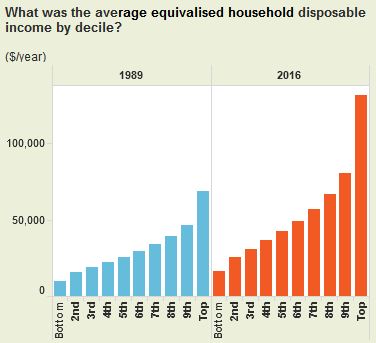
Average equivalised household disposable income in Australia has grown by 2.1% per year (from $30,942 to $53,711) for the last 27 years (1989-16).
This includes a 4 year period of falling incomes (2012-15) following the mining boom.


(Rising inequality? A stocktake of the evidence, Productivity Commission, 2018, p 13)

peaceandlonglife:
Over for the last 27 years, in absolute terms, the incomes of the top 10% have been growing, on average, 7 times faster than those of the bottom 10%.
In percentage terms, the income of the top 10% (2.4%) has been growing 29% faster than the bottom 90% (1.9%).


(Rising inequality? A stocktake of the evidence, Productivity Commission, 2018, p 44)

peaceandlonglife:
In Australia in 1989, the income ratio of the top 10% ($68,495) to the bottom 10% ($9,562) was 7.2 to 1.
By 2016 the income ratio of the top 10% ($131,560) to the bottom 10% ($16,495) had increased to 8.0 to 1.


(Rising inequality? A stocktake of the evidence, Productivity Commission, 2018)


Ratio of average income of the richest 20% to the poorest 20%.
(Richard Wilkinson & Kate Pickett, The Spirit Level, 2009)

Productivity Commission


[In the 2 years to 2014,] the income share held by the top 1% of households rose [by 12.5%:] from 4.8% [to] 5.4% …
Australians aged 25-34 have had declining incomes since 2009-10. …

[In 2015-16, children] under the age of 15 [had] the highest levels of both:
  • income poverty (11.5%, or about 530 000 children), and
  • consumption poverty (12.9%, or a little under 600 000) …
Private consumption poverty has risen in every survey interval since 1993-94. …
[Relative] income poverty [has not declined] despite 27 years of uninterrupted growth …
About half of Australians experienced income poverty at some point between 2001 and 2016. …
About [700,000 Australians] have been in income poverty continuously for at least the last 4 years. …

Among 28 OECD countries [Australia ranks:]
  • 3rd in median household wealth, [but]
  • [8th in equality of] wealth distribution …
[All] wealth deciles except the bottom one saw real increases in average wealth since the early 2000s.
The top half of the wealth distribution experienced particularly strong growth …
[The] wealth of the top decile increased by about $620,000 to reach $2.2 million, which is … about 7 times as much as the median person.
[By contrast, the] average wealth of the bottom decile actually fell … from about $10,000 to $8,000. …

Wealth inequality [in Australia] increased over the [12 years to 2015‑16] by 7%. …
The Gini coefficient for wealth (at about 0.6) is close to double the Gini coefficient for income (at about 0.3) …
[A] person at the 90th percentile of the wealth distribution has almost 40 times as much wealth as [a] person at the 10th percentile; for income, they have 4 times as much. …

[There] is less wealth mobility than income mobility, and more ‘stickiness’ at the top and bottom of the wealth distribution. …
If a father’s lifetime earnings are 10% above average for his generation, we would expect his son’s lifetime earnings to be 2–4% above average for his generation.
[Intergenerational earnings elasticity: 0.22 to 0.41]
peaceandlonglife:
An intergenerational earnings elasticity of 0.3 with a paternal income ratio of 8:1, confers an 87% income advantage to the sons of the richest 10% over the sons of the poorest 10%.
(Rising inequality? A stocktake of the evidence, August 2018)


(M Corak, Income inequality, equality of opportunity, and intergenerational mobility,
Journal of Economic Perspectives, 27:3, pp 79–102, 2013)

June 1, 2016

Alexis de Tocqueville

Blue Army: Persons of Interest


Thomas Piketty (1971):
The abolition of slavery posed difficult ideological problems to nineteenth-century proprietarian societies, which feared that abolition without compensation of slaveowners would ultimately undermine the whole proprietarian order and system of private property. …
Tocqueville … proposed in 1843 that half the indemnity be paid to slaveholders in the form of government annuities (hence by increasing the public debt, to be repaid by the taxpayers) and the other half by the slaves themselves, who would work for the state for ten years at low wages, allowing the wage differential to be used to reimburse their former owners.
In that way, he argued, the solution would be “fair to all participating parties,” since the former slaveowners would, after ten years, be obliged to pay “the increased price of labor” due to emancipation. …
[He also] proposed that former slaves be deprived of property rights for a long period of time, from ten to twenty years, to give them time to acquire a taste for work and effort; this lesson might be lost if they were to discover the comforts of property too quickly (and “unnaturally”).
(Capital and Ideology, 2019, emphasis added)

Alexis Clérel (1805 – 59)


[All] the particular circumstances which tend to make the state of a democratic community agitated and precarious … lead private persons more and more to sacrifice their rights to their tranquillity.
(p 842)

The nations of our day cannot prevent conditions of equality from spreading in their midst.
But it depends on themselves whether equality is to lead to
  • servitude or freedom,
  • knowledge or barbarism,
  • prosperity or wretchedness. …

In the United States the majority undertakes to supply a multitude of ready-made opinions for the use of individuals who are thus relieved from the necessity of forming opinions of their own. …
The fact that the political laws of Americans are such that the majority rules the community with sovereign sway, materially increases the power which the majority naturally exercises over the mind [of the individual.]
For nothing is more customary in man than to recognize superior wisdom in the person of his oppressor.
(p 520

In the United States, where the poor rule, the rich have always some reason to dread the abuses of their power.
(p 288, emphasis added)

[It] is easy to perceive that the wealthy members of the community entertain a hearty distaste to the democratic institutions of their country.
The populace is at once the object
  • of their scorn and
  • of their fears.
(p 207)

I know of no country … where the love of money has taken a stronger hold on the affections of men, and where the profounder contempt is expressed for the theory of the permanent equality of property.
(p 57)

In no country in the world do the citizens make such exertions for the common weal; and I am acquainted with no people which has established
  • schools as numerous and as efficacious,
  • places of public worship better suited to the wants of the inhabitants, or
  • roads kept in better repair.
(p 102)

In no country is criminal justice administered with more mildness than in the United States.
Whilst the English seem disposed carefully to retain the bloody traces of the dark ages in the penal legislation, the Americans have almost expunged capital punishment from their codes.
(p 694)

The safeguard of morality is religion, and morality is the best security of law and the surest pledge of freedom.
(p 48)

[However, religions] ought to confine themselves within their own precincts; for in seeking to extend their power beyond religious matters, they incur a risk of not being believed at all.
The circle within which they seek to bound the human intellect ought therefore to be carefully traced, and beyond its verge the mind should be left in entire freedom to its own guidance.
(p 532)

[Patriotism] and religion are the only two motives in the world which can permanently direct the whole of a body politic to one end.
(p 104)

The English … rarely abuse the right of association [through resort to violence,] because they have long been accustomed to exercise it.
In France the passion for war is so intense that there is no undertaking so mad, or so injurious to the welfare of the State, that a man does not consider himself honored in defending it, at the risk of his life.
(p 226)

It is in the general and permanent interest of mankind that men should not kill each other: but it may happen to be the peculiar and temporary interest of a people or a class to justify, or even to honor, homicide.
(p 765)

July 26, 2013

George W Bush

Blue Army: Persons of Interest


(Acts of War, ABC Afghanistan — Inside Australia's War, Episode 1, 2015)


George W Bush (1946):
The history of military conflict in Afghanistan has been one of initial success followed by long years of floundering and ultimate failure.
We're not going to repeat that mistake.

Stan Grant (1963):
The US has spent a colossal $2.26 trillion in Afghanistan, $88bn wen to training an equipping the Afghan forces.
(ABC The World This Week, 20 August 2021)

George W Bush (1946):
… I'm going to be judicious as to how to use the military.
It needs to be in our vital interest, the mission needs to be clear, and the exit strategy obvious.
(2000)

Every nation, in every region, now has a decision to make.
Either:
  • you are with us; or
  • you are with the terrorists.
(20 September 2001)

Matthew [12:30]:
He that is not with me is against me …
(King James Bible, 1611)

George W Bush (1946):
[Iran, Iraq and North Korea] constitute an axis of evil, arming to threaten the peace of the world.
(State of the Union Address, 29 January 2002)

Vladimir Lenin | Ulyanov (1870 – 1924):
Whoever is not with me, is against me.

John Kennedy (1917 – 63):
I will never compromise the principles on which this country is built, but we're not going to plunge into an irresponsible action just because a fanatical fringe in this country puts so-called national pride above national reason.
(Chris Matthews, Jack Kennedy: Elusive Hero, Simon & Schuster, 2011, Reader's Digest, 2013, p 215)

Proverbs:
Wisdom is the principal thing; therefore get wisdom: and with all thy getting, get understanding.
(4: 7)

Jonathan Haidt (1963):
[Ignorant] people see everything in black and white.
They rely heavily on the myth of pure evil and … are strongly influenced by their own self-interest.
The wise are able to:
  • see things from others' points of view;
  • appreciate shades of grey; and
  • [choose] a course of action that works out best for everyone in the long run.
(The Happiness Hypothesis, 2006)

Peter Singer (1946):
[It] is a mistake to divide the world neatly into good and evil, black and white without shades of grey, [because it] eliminates the need to learn more about those with whom one is dealing.
For an unreflective person to have a sense of "moral clarity" that disregards the shadings in human motivation and conduct can be a vice, not a virtue.
(The President of Good and Evil, p 250)

Dennis Howitt:
[The] thinking of terrorists exhibits the sort of cognitive distortions that are often found in people who commit other sorts of violence.
These … include the tendency to over-generalize the enemy's perceived failings to encompass the entirety of the population.
Perceptions are also dichotomised so that they are either good or they are bad with no shades of grey in between.
(Introduction to Forensic and Criminal Psychology, 4th Edition, Pearson, 2011 / 2012, p 229)

George Washington (1732 – 99):
The nation which indulges towards another an habitual hatred or an habitual fondness is in some degree a slave.
It is a slave to its animosity or to its affection, either of which is sufficient to lead it astray from its duty and its interest.

Theodore Roosevelt (1858 – 1919):
He who is not with us absolutely and without reserve of any kind is against us, and should be treated as an alien enemy …
We have room in this country for but one flag.
We have room for but one language.

William Clifford (1845 – 79) [Philosopher and Mathematician]:
Men speak the truth to one another when each reveres the truth in his own mind and in the other's mind …
[But] how shall my friend revere the truth in my mind when I myself am careless about it …
[When] I believe things [simply because] they are comforting and pleasant? …
The credulous man is father to the liar and the cheat. …

Charles Wesley (1707 – 88):
A charge to keep I have,
A God to glorify,
A never dying soul to save,
And fit it for the sky.

To serve the present age,
My calling to fulfill,
O may it all my powers engage
To do my Master's will!
(George W Bush, A Charge to Keep, 1999)

George W Bush (1946):
The liberty we prize is not America's gift to the world; it's God's gift to humanity. …
(2001)

I looked [Vladimir Putin] in the eye [and] I found him to be very straight forward and trustworthy.
We had a very good dialogue:
I was able to get a sense of his soul.
(Taking Control, Putin, Russia and the West, 2011)

Bush's Ethical Failure


This book [attempts] to cover all the possibilities.
When Bush speaks about his ethics, he is either sincere or he is insincere.
If he is insincere, he stands condemned for that alone.
I have started with the opposite, more generous assumption: that Bush is sincere, and we should take his ethic seriously, assessing it on its own terms, and asking how well he has done by his own standards. …
(p 267)

Whether [or not] he really believes in the … rhetoric that he uses … it is clear that Bush has no real interest in the policy details needed to achieve the aspirations he has voiced.
He has failed to follow through on most of the commitments he has made to work for a better, more just society.
He has said that deep, persistent poverty is unworthy of America's promise, but the number of Americans living in poverty increased in both 2001 and 2002.
(p 265)

Instead of combating that increase, Bush has pressed for tax cuts that hobble the government's capacity to do anything about it.
Rather than ensure that the nation he leads is a good global citizen, Bush has spurned institutions for global co-operation and set back the task of making the rule of law, rather than force, the determining factor in world affairs.
He has launched an unnecessary war, costly in [blood and treasure,] with a final outcome that is still uncertain.
His protection of the steel industry and his signature on a law authorising the largest-ever subsidies to American farmers shows his strong rhetoric about free trade to be a brutal hypocrisy that is driving millions of impoverished farmers in other countries deeper into poverty.
A comparison between the size of these subsidies and Bush's proposed increase in foreign aid makes his compassion look stingy.
(p 266)

He speaks of America's calling to promote democracy around the world, but his administration reacted positively to the first reports of an apparently successful coup against the left-leaning, but democratically elected, Venezuelan government of Hugo Chavez. …
[If] a candidate campaigns by stressing his moral character and his honesty, and then fails to make even a serious attempt to implement his campaign promises, he has damaged the moral fabric of democracy.
(p 257)

Handicapped by a naive idea of ethics as conformity to a small number of fixed rules, he has been unable to handle adequately the difficult choices that any chief executive of a major nation must face.
(p 266)

(The President of Good and Evil, 2004)


Saving Lives


[In] 2003 Bush … became convinced of the need for a major US initiative to tackle HIV/AIDS at a global level …
The bill he signed stipulated only that
  • one-third of the funds going to prevention should be set aside for programs that exclusively promote sexual abstinence until marriage;
    Scientific American:
    [The US spent $1.4 billion] over a 10-year period from 2004 through 2013 promoting abstinence … in sub-Saharan Africa.
    [According] to the most comprehensive independent study [to date] the money was more or less wasted. …
    Instead … one of the most important factors associated with lower levels of risky behavior was the number of years women remained in school. …
    [In addition, previous studies] showed that … at least a million lives [were saved] by making anti-HIV medications more widely available …
    (August 2016, p 12)
  • the remainder was available for use in programs promoting condom use. …
(pp 126-7)

[Started] under President George W Bush in 2005 the President's Malaria Initiative, or PMI, is … one of the best run and most effective of the US's worldwide health efforts. …
[The WHO has estimated that] 4.3 million fewer malaria deaths occurred between 2001 and 2013 [than had been expected based on] malaria patterns in 2000 …
The PMI accounted for a substantial part of [this ~47% reduction in mortality.]
The Program is based on four interventions:
  • insecticide-treated mosquito nets,
  • indoor spraying,
  • testing and treatment with artemisinin-based drugs, and
  • preventive treatment of pregnant women.
The next phase of the strategy, under the Obama administration, [seeks] to reduce malaria deaths by a [further 30% by 2020] in 19 target countries in sub-Saharan Africa and in the Greater Mekong region of Asia. …
Efforts will even aim to eliminate the disease in some countries. …

The secret to the initiative's success [is its logistical rigour.]
PMI's approach is holistic: [taking] responsibility for every link in the chain, from procurement to quality control.
[It] is a model [of] sustained focus on a limited number of targeted interventions in countries with a high burden of disease. …

[Nevertheless,] the overall global budget for malaria control is still projected to lag by more than $2 billion a year compared with what the mission requires …

(Global Role Model: A successful malaria program enters its second phase, Scientific American, May 2015, pp 16-7)

June 24, 2013

Theodore Roosevelt and Woodrow Wilson

PBS American Experience


Eric Rauchway [Professor of History, University of California, Davis]:
When [Woodrow Wilson] was a university professor, he said that he feared that teaching woman was atrophying his mental muscles.

Woodrow Wilson (1856 – 1924):
We have made partners of the women in this war ...
Shall we admit them only to a partnership of suffering and sacrifice and toil and not to a partnership of privilege and right?
(Appeal for Women's Suffrage, 1918)

Theodore Roosevelt (1858 – 1919):
Whilst the slaughter of the buffalo has been, in places, needless and brutal.
And while it is to be greatly regretted that the species is likely to become extinct, it must be remembered that its destruction was the condition necessary for the advance of white civilization in the West.
Above all, the extermination of the buffalo was the only way of solving the Indian question.
And its disappearance was the only method of forcing them to at least partially abandon their savage mode of life.
From the standpoint of humanity at large, the extermination of the buffalo has been a blessing.
(Hunting Trips of a Ranchman: Sketches of Sport on the Northern Cattle Plains, 1886)

Leave it as it is.
You can not improve on it.
The ages have been at work on it, and man can only mar it.
What you can do is to keep it for your children, your children's children, and for all who come after you …
(Grand Canyon, 6 May 1903)

We must handle the water, the wood, the grasses … so that we will hand them on to our children and children's children in better and not worse shape than we got them. …

Americanism … is a question of spirit, of conviction and purpose, not of creed or birthplace.
The test of our worth … is the service we render.

Theodore Roosevelt [Assistant Secretary of the Navy, Naval War College, June 1897]:
Cowardice is the unpardonable sin.
No triumph of peace is quite so great as the supreme triumphs of war.
The Nation must be willing to pour out its blood, treasure, and its tears like water rather than submit to the loss of honor and renown. …

David McCullough (1933) [Biographer]:
[TR] thought that what would destroy America was the 'prosperity at any price' attitude, the love of … 'soft living,' and a get-rich-quick theory of life. …

Roosevelt felt that a war would be good for the country.
It would stir up blood.
It would bring us together.
It was a noble aspiration, rather than the kind of self-serving grimy business of commerce and the mercantile ambitions of the country. …

Somebody once said of him that if you took all of Theodore and put it in a pot and boiled it down and down, what you've have at the bottom of the pot after that all was over was the preacher-militant. …

David Grubin:
… Roosevelt believed it his duty to urge people to do better.
He called the presidency 'a bully pulpit.'
(David Grubin, TR, PBS American Experience, 1996)

Woodrow Wilson (1856 – 1924):
Modern industry has so distorted competition as to put it into the power of some to tyrannize over many and enable the rich and strong to combine against the poor and weak. …
[The] President of the United States is [no] mere department of the Government [—] he is a human being trying to cooperate with other human beings in a common service. …

Jay Winter [Historian]:
Wilson's notion [was] that democracy was not only good for America but … good for the world …
[He entered the] war in 1917 because [he believed] the cause of war … was the existence of aristocratic, militaristic regimes, whose interests had nothing to do with the people.
Give the power to the people, Wilson believed, and wars would be impossible.
A democratic world would be a world without war. …
(Carl Byker & Mitch Wilson, Woodrow Wilson, PBS American Experience, 2002)

Ken Burns & Lynn Novick:
[World War I and] the anti-German propaganda produced by the Wilson administration's newly created Committee of Public Information set off a wave of hysteria about Germans and German Americans.
Sauerkraut was renamed 'Liberty Cabbage'.
Dachshunds were stoned to death.
Schoolchildren destroyed their German textbooks.
And an Illinois mob lynched an American citizen who's only crime had been speaking German over a neighbour's fence.
(A Nation of Drunkards, Prohibition, 2011)

A New Nationalism


[At 51, Theodore Roosevelt was] still ambitious, still driven to wield power, yet he held no political office and had little hope of one.
William Howard Taft was now President, and Roosevelt himself had put him in office, but he believed that Taft was turning against him, siding more and more with the conservative wing of the Republican Party, crippling many of the reforms for which Roosevelt had fought so hard. …

[In the summer of 1910, TR] called for a 'New Nationalism,' …
The New Nationalism … implies far more governmental interference with social and economic conditions.
Every man holds his property subject to the general right of the community to regulate its use. …
[He] attacked the courts as pro-business, advocated taxes on income and inherited wealth, stronger conservation measures, workman's compensation laws, the prohibition of child labor.

In June 1912, the Republicans met in Chicago [and nominated President Taft to run for a second term. …]

Roosevelt's [break-away Progressive Party] endorsed a sweeping charter for
  • votes for women,
  • a minimum wage,
  • abolition of child labor,
  • unemployment insurance,
  • old-age pensions.
John Morton Blum (1921 – 2011) [Historian]:
He came out for a social welfare program far more advanced than anything the nation was going to know until the 1930's.

William Harbaugh [Historian]:
Here is the inception … of Social Security, even of Medicare in that platform. …

Theodore Roosevelt (1858 – 1919):
We stand for a living wages.
Wages are subnormal if they fail to provide a living for those who devote their time and energy to industrial occupation.
A standard high enough to make morality possible, to provide for education and recreation, to care for immature members of the family, to maintain the family during periods of sickness, and to permit a reasonable saving for old age.
We hold the seven-day working week is abnormal and hold that one day of rest in seven should be provided by law. …

William Harbaugh:
There was no possibility whatever that the Progressive Party could actually win the election.
It's simply inconceivable that, on its first run, a third party should have polled enough votes.
Roosevelt lost in a landslide, and the Democrats [under Woodrow Wilson] captured both houses of Congress. …
His defeat struck a blow to the [progressive wing of the Republican Party] from which [it] never recovered …
His rebellion had made a Democrat President, and the Republicans would not forgive him.


A World Without War


[Wilson and his advisors envisioned] a new world order based on democracy. …

[Key] Republicans, led by Senator Henry Cabot Lodge [were] determined to voice their opposition to giving up US sovereignty to [proposed the League of Nations. …]

Wilson warned that the League was the only hope for reconciliation among Germany, Britain and France.
Without it, he prophesied that there would be a "Second World War."
Woodrow Wilson (1856 – 1924):
I do not hesitate to say that the war we have just been through, though it was shot through with terror of every kind, is not to be compared with the war we would have to face next time.
What the Germans used were toys as compared with what they would use in the next war. …
[Cabot] Lodge introduced a series of amendments … that severely limited American commitments to the organization.
[When these proved unacceptable to Wilson] the League of Nations went down to final defeat in the Senate.

June 5, 2013

The World 2

George W Bush


Colin Powell (1937):
[The sanctions against Iraq exist] for the purpose of keeping in check Saddam Hussein's ambitions toward developing weapons of mass destruction. …
[They] have worked.
He has not developed any significant capability with respect to weapons of mass destruction.
(Cairo, February 2001)

George W Bush (1946):
Intelligence gathered by this and other governments leaves no doubt that the Iraq regime continues to possess and conceal some of the most lethal weapons ever devised.
(48 hour ultimatum speech, 17 March 2003)

May 11, 2013

George H W Bush

Blue Army: Persons of Interest


George H W Bush (1924 – 2018):
Where is it written that we must act as if we do not care?
As if we are not moved.
Well I am moved.
I want a kinder, gentler nation.
(Republican National Convention, New Orleans, 1988)

Marc Sandalow [Associate Academic Director, Washington Program, University of California]:
After the Tiananmen Square massacre in [1989, Nancy Pelosi sponsored legislation that] would have allowed Chinese exchange students in San Francisco not to be forced to go home when their visas expired because they were worried about persecution.
… George H W Bush vetoed that legislation, and the Congress overrode his veto.
(Nancy Pelosi: The most powerful woman in US politics, ABC Rear Vision, 24 February 2019)

Margaret MacMillan (1943):
In 1991, the American televangelist Pat Robertson warned that Bush Sr’s victory over Iraq was not what it appeared.
It was paving the way not for peace but for the triumph of evil.
It was all so clear to Robertson.
Ever since the Bolshevik Revolution of 1917, a secret conspiracy had been pushing the world toward socialism and the triumph of the Antichrist.
The European Union was clearly part of the plot and so was the United Nations.
The Gulf War and the missiles that Saddam Hussein had fired on Israel were yet more steps toward the final reckoning.
(The Uses and Abuses of History, Profile, 2009, pp 64-65)


On the Distinction Between True and False Visions


[Ronald Reagan (1911–2004),] who spent World War II in Hollywood, vividly described his own role in liberating Nazi concentration camp victims. …
On many occasions in his Presidential campaigns, [Reagan recounted his] epic story of World War II courage and sacrifice, an inspiration [to] all of us.
Only it never happened …
[It] was the plot of the movie A Wing and a Prayer
{Living in the film world, he apparently confused a movie he had [experienced] with a reality he had not.}

Many other instances of this sort can be found in Reagan's public statements.
It is not hard to imagine serious public dangers emerging out of instances in which political, military, scientific or religious leaders are unable to distinguish fact from … fiction.

(Carl Sagan, The Demon Haunted World, 1997, p 132)


Ceiling and Visibility Unlimited


In many ways George Bush was what Ronald Reagan pretended to be.
As an actor, Ronald Reagan played the war hero.
George Bush was a war hero — a decorated naval aviator.
Ronald Reagan played the athlete.
George Bush was the captain of his Yale baseball team and played twice in the college championship game.
He was also a first rate tennis player.
Both preached family values, but only Bush could point to a happy family.


After four decades of public life, George Bush feels his most important accomplishment in life is that his children still come home. …
When Ronald Reagan learned he had Alzheimer's disease, he wrote a letter for history.
He addressed it to the American people.
[Nine] years after his defeat, George Bush [also] wrote a letter.
He addressed it to his children. …
George H W Bush (1924 – 2018):
I had a little plaque made.
It says CAVU [—] the kind of weather we Navy pilots wanted when we were to fly off our carrier in the Pacific — "Ceiling and Visibility Unlimited."
I will not pass by it without realizing how lucky I am …
[For] the plaque describes my own life — as it has been over the years, as it is right now.
After leaving office, Bush saw his son George W get elected Governor of Texas, and his son Jeb Governor of Florida. …
[And when] George W was elected president in 2000, it was the first time a father and son had occupied the White House since John and John Quincy Adams almost 200 years earlier.


February 11, 2013

Richard Nixon

PBS American Experience


Pure and Simple Politics

I saw Watergate as politics, pure and simple. …

By law and order, I mean law and order for everyone …

I have expressed to the appropriate authorities, my view that no individual holding … a position of major importance in the administration, should be given immunity from prosecution.
I condemn any attempts to cover-up in this case, no matter who is involved. …

[When] the President does it, that means that it is not illegal. …

Always remember, others may hate you, but those that hate you don't win,
unless you hate them.
And then, you destroy yourself.


Richard Nixon (1913 – 94)


Nixon wanted the presidency so bad that there were no depths he wouldn't sink to.

John Kennedy (1917 – 63), November 1960.


Robert Mann (1958):
[In 1968, Richard Nixon saw peace in Vietnam] as a direct threat to his [Presidential election] campaign.
So he actively began working to sabotage the peace talks by turning the South Vietnamese government against any preelection peace agreement.
[He] quietly sent word to the South Vietnamese that they should hold out for a better deal under a Nixon administration.
(The Complete Idiot's Guide to The Cold War, Alpha, 2002, p 213)

Richard Nixon (1913 – 94):
My God!, I would never do anything to encourage Saigon not to come to the [negotiating] table …
(Taped Conversation with President Johnson, 1968)
Daniel Ellsberg (1931):
It's not that we were on the wrong side.
We were the wrong side.
(Judith Ehrlich & Rick Goldsmith, The Most Dangerous Man in America, 2009)
Charles Ferguson (1955):
Infuriated by leaks to the media, Nixon orders John Ehrlichman to create a secret White House organisation to identify leakers and attack them, starting with Daniel Ellsberg.

Richard Nixon (1913 – 94):
Don't get the impression that you [in the media] arouse my anger.
One can only be angry with those he respects.

Gerald Ford (1913 – 2006) [40th Vice President of the United States]:
[It's] my judgement that the evidence is overwhelming that he had nothing to do with the so-called cover-up.
So the President, in my judgement is innocent, and will be exonerated.
(27 July 1974)

I, Gerald R Ford, President of the United States, do grant a full, free and absolute pardon unto Richard Nixon.
(8 September 1974)

Charles Ferguson (1955):
[The] pardon was part of a larger deal that eventually gave Nixon control over the tapes. …
For the rest of his life, Richard Nixon fought to keep the tapes secret.
After Nixon's death in 1994, Professor Stanley Kutler forced the release of many new tapes.

Gerald Ford (1913 – 2006) [38th President of the United States]:
There was no deal, period, under no circumstances.
(House Judiciary Committee Hearing)

Charles Ferguson (1955):
In 1978, Carter signed into law the Ethics in Government Act, which guaranteed the independence of special prosecutors.
It was allowed to expire in 1999 [under Bill Clinton.]

Bob Woodward (1943):
What was Watergate?
The five wars of Watergate:

  1. [the war] against the anti-war movement,
  2. [the war] against the news media,
  3. the war against the Democrats,
  4. the war against justice, and …
  5. the war against history.

(Watergate, 2018)

The White House Tapes


Richard Nixon (1913 – 94):
For once we've got to use the maximum power of this country against this shit-ass little country, to win the war. …
[Henry, the] only place where you and I disagree … is with regard to the bombing.
You're so goddamned concerned about the civilians.
And I don't give a damn. …
I still think we ought to take the dikes out now.
Will that drown people?

Henry Kissinger (1923) [National Security Advisor]:
That will drown about 200,000 people.

Richard Nixon (1913 – 94):
Well, no …
I'd rather use a nuclear bomb.
Have you got that ready?

Henry Kissinger (1923):
That, I think, would just be too much.

Richard Nixon (1913 – 94):
I just want you to think big, Henry.
For Christ's sakes.
(25 April 1972)


Richard Nixon (1913 – 94):
Now, you remember Huston's plan?
I want it implemented on a thievery basis!
Goddamit, get in, get those files [at the Brookings Institution on Johnson's bombing halt.]
Blow the safe and get it.
(16 June 1971)

Richard Nixon (1913 – 94):
Those sonsofbitches [at The New York Times] are killing me.
We're up against … an enemy.
A conspiracy.
They're using any means.
We are going to use any means.

Did you get the Brooking Institute raided last night? …
No?
Get it done.
I want the Brookings safe cleaned out.
(1 July 1971)


Richard Nixon (1913 – 94):
Just say, [that the Watergate break-in] was a comedy of errors, and [the CIA] should call the FBI in, and say that, for the country, don't go any further into this one.
Tell them, lay off.
I don't want them to get any ideas that we're doing it because our concern is political.
(23 June 1972)

Richard Nixon (1913 – 94):
I want the most comprehensive notes on all those who have tried to do us in.
We haven't used the power in the first four years.
We haven't used the Bureau.
We haven't used the Justice Department.
But things are gonna change now.

John Dean (1928) [White House Counsel]:
That's an exciting prospect.
(25 September 1972)


Richard Nixon (1913 – 94):
A 35-year sentence [for the Watergate burglars]?
There were no weapons, right?
No injuries?
That's just ridiculous.
One of these blacks holds up a store with a goddamn gun, they give him two years.
Probation after six months. …
[The burglars] expect clemency within a reasonable times? …
You couldn't do it, say, in six months? …

John Dean (1928):
No. …

Richard Nixon (1913 – 94):
Jesus Christ.
The main thing is the isolation of the President from this.
Because that, fortunately, is totally true.
(28 February 1973)


John Dean (1928):
We have a cancer, within, close to the Presidency …
[Arrangements] had to be made …
[The burglars] had to be taken care of. …
And that is an obstruction of justice.

Richard Nixon (1913 – 94):
The fact that you're taking care of witnesses. …

John Dean (1928):
Now, the continuing blackmail [by the burglars] will go on …
People here are not pros at this.
This is the sort of thing mafia can people do.
Washing money?
We just don't know about these things.
We're not criminals.

Richard Nixon (1913 – 94):
That's right.
How much money do you need?

John Dean (1928):
I would say, a million dollars over the next two years.

Richard Nixon (1913 – 94):
We could get that. …
I know where it could be gotten. …

John Dean (1928):
We cannot let you be tarnished. …

Richard Nixon (1913 – 94):
The obstruction of justice. …
We're all in it.
I think, up to this point, we had certain choices.
But that's gone.
(21 March 1973)


Henry Kissinger (1923):
I don't know a damn thing about Watergate, and I don't want to.
But where are the civil libertarians?
A judge gives somebody a 55-year sentence in order to make him talk.
Where's the protection of the Fifth Amendment? …
It was a simple case of burglary.
First offenders.
People who would never do it again.

Richard Nixon (1913 – 94):
Trying to make them talk, it's unbelievable.
(27 March 1973)


Lowell Weicker (1931) [Senator from Connecticut (R), Watergate Committee]:
I thing the political repercussions … are gonna be a lot worse if we don't get all than facts than if we do get all the facts. …
I think the nation, the Republican Party, the entire political system, is hurt far more by facts being concealed, by witnesses being shielded than by fellows like McCord and others coming forth and laying it all on the line.
(Television interview)

Richard Nixon (1913 – 94):
I want you to get the goods Weicker.
I think we've got to play a damn tough game on him.
Have they done the checking on his financial statements?
Is his income tax being checked yet?
(30 March 1973)


Richard Nixon (1913 – 94):
Today … I accepted the resignations of two of my closest associates in the White House.
Bob Haldeman.
John Ehrlichman. …
I want the American people to know beyond the shadow of a doubt that, during my term as president, justice will be pursued fairly, fully, and impartially.
No matter who's involved.
(30 April 1973)

Charles Ferguson (1955):
Shortly afterwards, Nixon secretly rehired Haldeman and Ehrlichman as consultants …
By this point, Kissinger had secretly taped 15,000 phone calls.
He later destroyed the tapes.
Others were secretly taping each other, planting rumors, hiring criminal lawyers, and looking for new jobs.
(Things Fall Apart, Watergate, Episode 3, 2018)


Richard Nixon (1913 – 94):
I frankly thought [the Watergate burglary] was a CIA thing. …
This was a Dean plot, period.
I didn't do it. …
Suppose I had called him in, and said,
Look, concoct a story to the CIA …
Well, Goddammit, he can't say that.
It's … it's totally privileged. …
And beyond that, it's totally not true.
(11 May 1973)

Richard Nixon (1913 – 94):
I haven't got a tape [of my conversations with John Dean.]
I don't have any tape.
(6 June 1973)

Pat Buchanan (1938) [Strategist and Speechwriter]:
I sent Nixon a memo, I said,
You're gonna have to keep the Dean tapes … and all the other foreign policy tapes.
Take the rest of them out and burn them …
[Get] rid of the Archie Cox and the special prosecutor's office of the independent counsel.
Shut the thing down because this is gonna grow into a monster, and it will kill us.

Charles Ferguson (1955):
What did you think when you learned that [Vice President Spiro Agnew] had, in fact, been taking bribes in?

Pat Buchanan (1938):
… I wrote him a note, and I said …
I think [that, by resigning,] you've set a standard for courage in politics by a Vice President that will stand for a long time.
I just told him how much I admired him and regret what was happening to him.

Would you like to know more?