Showing posts with label Miniplenty. Show all posts

July 4, 2021

Gigi Foster

Blue Army: Persons of Interest


An Epidemic of Socialism

COVID didn't crush the economy.
Government crushed the economy.


Kristi Noem (1971), Govenor of South Dakota, CPAC, 2021.


[You] need to control the virus to get people back to work.

Alan Kohler (1952)


(ABC News, 2 September 2020)


(ABC News, 7 December 2020)


Liberty Or Death

(Pandemic 2020)


Gigi Foster


Associate Professor of Economics, UNSW Business School.
PhD (Economics), University of Maryland.
BA (Ethics, Politics, and Economics), Yale University.


Are Lockdowns a Crime Against Humanity?


The Nuremberg code [is] a code of ethical standards …
It's something that, essentially, the war criminals of period during the WWII atrocities were facing, in the 1950s kind of period, to try to draw them to account for the massive damage they had done, the genocides.
And this code is something that requires governments defend the actions on the basis of public health.
So the sixth Nuremberg code demands that the decision maker must have a reasonable view that the benefits of an intervention will be higher than the costs, and failure to abide by that is a crime against humanity …
Museum Note:
On August 19, 1947, the judges of the American military tribunal in the case of the USA vs Karl Brandt et al … confronted the difficult question of medical experimentation on human beings. …
Although the [Nuremberg] code addressed the defense arguments in general remarkably none of the specific findings against Brandt and his codefendants mentioned the code.
Thus the legal force of the document was not well established.
The uncertain use of the code continued in the half century following the trial when it informed numerous international ethics statements but failed to find a place in either the American or German national law codes.
Nevertheless, it remains a landmark document on medical ethics …

Permissible Medical Experiments:
The degree of risk to be taken should never exceed that determined by the humanitarian importance of the problem to be solved by the experiment.
(Nuremberg Code, United States Holocaust Memorial Museum)
Have you seen a cost-benefit analysis produced by the government to defend its decisions during this period?
To strip people of their liberties.
To close schools.
To shut borders.
To cease trade.
I went for months waiting for that and finally produced one on the back of a cocktail napkin basically myself [in approximately … 15 hours in August 2020.]

[You can't assume] that it was those tough early restrictions that, as a package, created the outcomes we've seen.
My reading of the data is that pretty much how well or not you did in this period health-wise and economics-wise was kind of unrelated whether you locked down really hard or not so hard or whatever.
In fact the best thing to do probably would have been to target of our protection and our attention to the people who were actually vulnerable to this virus, and to invest in things like prophylactic treatments evaluation and evaluation of what can we do, medicines we can use, not just vaccines, but all sorts of cheaper things, when somebody gets the virus to prevent them getting serious symptoms. …

[We're] an island nation …
But there are many [other] reasons why the virus didn't run like it did, in the US for example, here that have nothing to do with our policy responses and you can compare Victoria to NSW if you want to get a sense of what's possible without locking down. …


[We] knew that this thing was killing mainly older people … which is why … in March of last year I called for the radical protection of older people, people in danger from this virus, and everybody else be allowed to go about their business as they deemed fit …
And the thing is, it's very uncomfortable right now to admit that we messed up.
For the politicians to admit it …

(Lockdowns and the path forward , ABC The Economists, 24 June 2021)


If you look at the people who have died from [COVID-19, they] have 5-6 years on average still to live …
How much does a developed society typically spend in normal times per [Quality Adjusted Life Year?]
Usually somewhere between $50,000 and $150,000 per QALY. …
Office of Best Practice Regulation:
Willingness to pay is the appropriate way to estimate the value of reductions in the risk of physical harm – known as the value of statistical life.
Based on international and Australian research a credible estimate of … the value of statistical life year is $195,000 in 2018 dollars.
(Best Practice Regulation Guidance Note: Value of statistical life, Department of the Prime Minister and Cabinet, Australian Government, October 2018)

William Viscusi (1947):
Unlimited personal freedoms will lower our well‐being, particularly when confronting crises for which collective, responsible behavior is desirable.

Mortality costs of COVID‐19 in Australia as of January 1, 2021
(Table A1 extract)
Number of deaths909
VSL ($ millions)8.6636
VSL × deaths ($ millions)7875
VSL = Value of a Statistical Life

(Economic lessons for COVID‐19 pandemic policies, South Economic Journal, 4 March 2021)
[So] every death we [prevent] from COVID-19 is [worth] around $500,000 and $600,000. …
Then you have a currency. …
Then you can say … when we do this lockdown:
  • [Firstly,] are we actually preventing that many more deaths?
  • [Secondly,] whatever number we are saving [we] multiply that by whatever the amount is we're willing to spend in normal times to save that amount of lives, that quality of life.
[Then] we get a dollar figure.
And then we can say: …
Is the economic cost of implementing these measures less than that?
  • [If] so — good idea.
  • If not — let's think about it more.
(Who'll pay the COVID-19 bill?, ABC The Signal, 5 May 2020)


What Have The Capitalists Ever Done For Us?


[Shutdowns are] very much a cure that's worse than the disease …
We had Trump saying that, by Easter, he wants things to be back on game …
He's right … to try to give a stopping point, to try to increase a bit of certainty about what to expect.
Because businesses … are in free freefall — people are stressed and they're going to be dying from that at some stage. …

This is the way that economies in communist systems organise …
[Whereas, Capitalism] has kept us all doing so well and having such luxurious lives, by historical and international comparisons, for so long. …

We know GDP is a huge predictor of [longevity.]
[Life] spans have increased over the last 100 years … on the back of rises in GDP per capita that pay for research and development, and health … and education services, and better roads, and everything that makes our lives better …
We giving that up with every day we are in shutdown …

[The global response to COVID-19] is actually killing people …
I'm talking about statistical lives lost.
Human welfare which is tanking because the economy is tanking. …

[Keeping the economy running] saves many more lives than are saved by quarantining the entire economy …
[The tradeoff is] not lives against money, it's lives against more lives. …

We need to be aggressively targeting isolation of older people, because those are the people who are dying. …
But to say to young people you should stay home and worry, and not go to pubs, is … absolutely a disgrace.
[These people] won't die from it — under 40 it's a 0.2% death rate …
[When Boris Johnson] could not stay that ["herd immunity"] course in the face public opinion — that was an entirely political move. …


The young people who lived through this, the coronavirus cohort, they are going to see negative effects throughout their lives because of what has already happened.
The longer this goes on, the worse off those people are going to be, 10 years, 20 years, 30 years …

I just want to see us open for business as soon as possible.

(As the coronavirus marches on, can wartime measures save us from a depression?, ABC The Economists, 26 March 2020)

November 25, 2019

John Quiggin

Green Army: Persons of Interest


[The] culture wars are just a device to keep the right-wing base agitated enough to turn out [and] keep pro-rich politicians in office. …
The great majority of [climate change] “sceptics” are, in fact, credulous believers in what they are told by trusted authority figures, notably including conservative political leaders.


Climate claims a victory in the culture wars, Inside Story, 17 December 2015.


The Global Financial Crisis has shown that, for most of the past decade, market estimates of the relative riskiness and return of alternative investments have been entirely unrelated to reality. …

In Australia … it has become routine for retired politicians, of all political persuasions, to be offered cushy jobs in the financial sector, provided, of course, that they have followed the right kinds of policies when in office. …
Public office is no longer a goal in itself but a stepping stone to bigger and more profitable goals.
The incentives to promote the interests of the financial sector while in office are obvious. …

An analysis by the New Economics Foundation concluded that for each pound paid to British bankers, society incurred a net loss of ten pounds. …
A study by the Center for Responsive Politics showed that about two-thirds of US senators were millionaires in 2008.


— Zombie Economics, Princeton University Press, 2012, pp 190, 186, 174-5.


Traditional models of on-the-job training (apprenticeships and traineeships) are in decline.
Funding for vocational education through the Technical and Further Education (TAFE) system has been slashed leading to the closure of manyTAFEs and large-scale loss of teaching staff.
Meanwhile, billions of dollars have been wasted on ideologically driven experiments with market competition and forprofit provision.


— Submission to the South Australian Senate inquiry into Vocational Education and Training.

July 9, 2017

Milton Friedman

Blue Army: Persons of Interest


Soak the Rich

Advocates of capitalism are very apt to appeal to the sacred principles of liberty, which are embodied in one maxim:
The fortunate must not be restrained in the exercise of tyranny over the unfortunate.


Bertrand Russell (1872 – 1970), Freedom in Society, Sceptical Essays, 1928.


Everything that is economically efficient is morally justified.

Yegor Gaidar (1956 – 2009)


[Greed] is good.
Greed is right.
Greed works.
Greed … captures the essence of the evolutionary spirit.
Greed … for life, for money, for love, [for] knowledge has marked the upward surge of mankind.


Oliver Stone (1946), Wall Street, 1987.


Greed is never good.

Linus Torvalds (1969)


[The inordinately wealthy] corrupt themselves by practising greed, and they corrupt the rest of society by provoking envy.

Ernst Schumacher (1911 – 77), Small is Beautiful, Part IV, Chapter 5, 1973.


[The] chief business of the American people is business.

Calvin Coolidge (1872 – 1933)


We're going to turn the bull loose.

Ronald Reagan (1911 – 2004)


(Michael Kirk, President Trump, PBS Frontline, WGBH, 2017)

Thomas More (1478 – 1535):
I can have no other notion of all the other governments that I see or know, than that they are a conspiracy of the rich, who, on pretence of managing the public, only pursue their private ends, and devise all the ways and arts they can find out; first, that they may, without danger, preserve all that they have so ill-acquired, and then, that they may engage the poor to toil and labour for them at as low rates as possible, and oppress them as much as they please; and if they can but prevail to get these contrivances established by the show of public authority, which is considered as the representative of the whole people, then they are accounted laws …
(Utopia, 1516)

Adam Smith (1723 – 90):
People of the same trade seldom meet together, even for merriment and diversion, but the conversation ends in conspiracy against the public, or in some contrivance to raise prices. …
It is impossible to prevent such meetings, by any law which either could be executed, or would be consistent with liberty and justice.
But though the law cannot hinder people of the same trade from sometimes assembling together, it ought to do nothing to facilitate such assemblies; much less to render them necessary.
(Book 1, The Wealth of Nations, Chapter 10, Part 2, 1776)

October 15, 2016

Robert Putnam

Green Army: Persons of Interest


Poverty amongst riches is the most grievous form of want.

Lucius Seneca (~4 BCE – 65 CE), Epistulae morales ad Lucilium, LXXIV, 4, adapted.


No society can be flourishing and happy, of which the greater part of members are poor and miserable.

Adam Smith (1723 – 90)


We got to keep these here people down or they'll take the country. …
Outlanders.
Foreigners.
Sure, they talk the same language, but they ain't the same.
Look how they live. …
Why, Jesus, they're as dangerous as niggers in the South!
If they ever get together there ain't nothin' that'll stop 'em.


John Steinbeck (1902 – 68), The Grapes of Wrath, 1939, p 250.


John Kennedy (1917 – 63):
If a free society cannot help the many who are poor, it cannot save the few who are rich.
(Chris Matthews, Jack Kennedy: Elusive Hero, Simon & Schuster, 2011, Reader's Digest, 2013,
p 129)

Abraham Lincoln (1809 – 65):
Fellow citizens, we cannot escape history. …
The fiery trial through which we pass, will light us down, in honor or dishonor, to the latest generation. …
The dogmas of the quiet past, are inadequate to the stormy present. …
In giving freedom to the slave we assure freedom to the free. …
We must disenthrall ourselves, and then we shall save our country.
(Message to Congress, 1 December 1892)

Clement Vallandigham ( 1820 – 71) [Leader, Peace Democrats, 14 January 1863]:
I see more of barbarism and sin, a thousand times, in the continuance of this war … and the enslavement of the white race by debt and taxes and arbitrary power [than in Negro slavery.]
In considering terms of settlement [with the South, we should] look only to welfare, peace, and safety of the white race, without reference to the effect that settlement may have on the African.
(James McPherson, Battle Cry of Freedom, 2nd Edition, Oxford University Press, 2003, p 513)

George Gilder (1939):
In order to succeed … the poor need, most of all, the spur of their poverty.
(Wealth and Poverty, 1981)

Robert Putnam (1941):
Over the four decades between 1974 and 2014, inflation-adjusted annual market income
  • fell $320 for households at the 10th percentile (the bottom tenth),
  • rose $388 for those at the 20th percentile (the bottom fifth),
  • rose $5,232 for those at the national median,
  • rose $75,053 for households in the top 5 percent,
  • rose $929,108 for those in the top 1 percent, and
  • rose $4,846,718 for those in the top 0.1 percent. …
If today’s income were distributed in the same way that 1970 income was distributed, it is estimated,
  • the bottom 99 percent would get roughly $1 trillion more annually, and
  • the top 1 percent would get roughly $1 trillion less.
(The Upswing, 2020)

Would you like to know more?

Mark Blyth (1967):
72% of the working population [in the US live from] paycheck to paycheck, have few if any savings, and would have trouble raising $2000 on short notice.
(Austerity, Oxford University Press, 2013, p 48)

Thomas Jefferson (1743 – 1826):
All eyes are opened, or opening, to the rights of man.
The general spread of the light of science has already laid open to every view the palpable truth that the mass of mankind has not been born with saddles on their backs; nor a favored few booted and spurred, ready to ride them legitimately, by the grace of God.
(Letter to Roger C Weightman, 24 June 1826)

Kim Robinson (1952):
There were of course very powerful forces on Earth adamantly opposed to … creating full employment …
Full employment, if enacted, would remove “wage pressure” — which phrase had always meant fear struck into the hearts of the poor, also into the hearts of anyone who feared becoming poor, which meant almost everyone on Earth.
This fear was a major tool of social control, indeed the prop that held up the current order despite its obvious failures.
Even though it was a system so bad that everyone in it lived in fear, either of starvation or the guillotine, still they clutched to it harder than ever.
(2312, Orbit, 2012, p 373-4)

Ridley Scott (1937):
Quite an experience to live in fear, isn't it?
That's what it is to be a slave.
(Blade Runner, 1982)

American Political Science Association Task Force on Inequality and American Democracy:
Today, the voices of American citizens are raised and heard unequally.
The privileged participate more than others and are increasingly well organized to press their demands on government.
Public officials, in turn, are much more responsive to the privileged than to average citizens and the least affluent.
Citizens with lower or moderate incomes speak with a whisper that is lost on the ears of inattentive government officials, while the advantaged roar with a clarity and consistency that policy-makers readily hear and routinely follow.
(American Democracy in an Age of Rising Inequality, Perspectives on Politics, December 2004, p 651)

Don Watson (1949):
[The US minimum wage has fallen by a third since 1968.]
More than 20% of children in the United States live in poverty, more than twice the rate of any European country.
[The Australian child poverty rate is 17.4%.]
With a quarter of totalitarian China's population, democratic America has about the same number of people in jail.
(Enemy Within: American Politics in the Time of Trump, Issue 63, 2016, p 34)

Sean Reardon [Sociologist, Stanford University]:
The achievement gap [in education] between children from high- and low-income families is roughly 30–40% larger among children born in 2001 than among those born 25 years earlier.
(The Widening Academic Achievement Gap Between the Rich and the Poor: New Evidence and Possible Explanations, in Whither Opportunity? Rising Inequality, Schools, and Children’s Life Chances, Greg Duncan & Richard Murnane, Editors, Russell Sage Foundation, 2011)

Andrew Cherlin:
The wages of men without college degrees have fallen since the early 1970s, and the wages of women without college degrees have failed to grow.
(Demographic Trends in the United States: A Review of Research in the 2000s, Journal of Marriage and Family, 72, June 2010, p 404)

Milton Friedman (1912 – 2006):
[In] a free choice [educational] system, you would have more heterogeneous schools [and] far less segregation by social and economic class than you now have. …
I went to a state school, Rutger's university.
I went on a state scholarship.
The poor suckers in the state of New Jersey paid for my going to college.
I personally think that was a good thing. ….
[And] I don't see any reason whatsoever, why I shouldn't have been required to pay back that money.
(What's Wrong With Our Schools, Free to Choose, Episode 6, PBS, 1980)

Robert Putnam (1941)


A World Without Trust


I've told you about my granddaughter, Miriam …
Mary Sue and Miriam are exactly the same age.
They are both granddaughters of Port Clinton [Ohio] in the 1950s. …
I'm just going to read to you, the field notes from [our meeting with Mary Sue:]
Mary Sue tells a harrowing tale of loneliness, distrust and isolation.
Her parents split up when she was 5.
And her mother turned to stripping and left her alone and hungry for days.
Her dad hooked up with another woman who hit her, refused to feed her, and confined her to room with baby-gates.
Caught trafficking marihuana at 16, Mary Sue … spent several months in a juvenile detention center, failed out of high school and got a "diploma" online.

[Mary Sue's] experiences have left her with a deep seated mistrust of anyone and everyone embodied in the scars on her arms (which we saw) where her boyfriend had burned her in the middle of the night, just a few days earlier.
Mary Sue wistfully recalls her stillborn baby, born when she was 13.
Since breaking up with the baby's dad, who left her for someone else, and with a second fiance who cheated on her after his release from prison, Mary Sue is currently dating an older man with two infants born two months apart to two other women.
And to Mary Sue this feels like the best that she can hope for. …

Mary Sue posted on facebook, not long ago, that she'd figured out her problems.
Her problem, she said, is that no one in the world loves her — which is probably true …
And, she's figured out how to solve that problem.
Mary Sue's going to have baby, because the baby will love her.
And if you think Mary Sue is in a pickle, imagine Mary Sue's baby …

[The] most important feature of the life of a poor kid in America today, bar none, is that poor kids are isolated and alone.
And they don't trust anyone.
They don't trust their parents …
They don't trust schools.
They don't trust anybody.

Mary Sue recently posted on facebook:
Love hurts.
Trust kills.
Think what it means to grow up in a society in which you cannot trust anyone.

(Closing the Opportunity Gap, RSA, 6 October 2015)

July 23, 2016

Ministry of Plenty

Live Long and Prosper


What would become of business without a market of fools?

Chuang Tzu, 4th century BCE.

John Adams (1735 – 1826) [2nd President of the United States]:
The envy and rancor of the multitude against the rich is universal and restrained only by fear or necessity.
A beggar can never comprehend the reason why another should ride in a coach while he has no bread.
(Zoltan Haraszti, John Adams and the Prophets of Progress, Harvard, 1952, p 205)

Alexander Hamilton (1756 – 1804):
Why has government been instituted at all?
Because the passions of men will not conform to the dictates of reason and justice without constraint.
(Federalist No 15 Papers, 17 September 1787)

Peter Singer (1974):
For all the claims that “big government” can never match the private sector, [the Defence Advanced Research Projects Agency] is the ultimate rebuttal.
The Internet … e-mail, cell phones, computer graphics, weather satellites, fuel cells, lasers, night vision, and the Saturn V rockets [that first took man to the moon] all originated at DARPA. …
DARPA works by investing money in research ideas years before any other agency, university, or venture capitalists on Wall Street think they are fruitful enough to fund.
DARPA doesn’t focus on running its own secret labs, but instead spends 90% of its (official) budget of $3.1 billion on university and industry researchers …
(Wired for War, Penguin, 2009, p 140)

Mayer Rothschild (1744 – 1812):
If you can't make yourself loved, make yourself feared.
(p 89)

Niall Ferguson (1964):
The first era of financial globalization took at least a generation to achieve.
But it was blown apart in a matter of days.
And it would take more than two generations to repair the damage done by the guns of August 1914.
(The Ascent of Money, Penguin, 2008, p 304)

Andrew Carnegie (1835 – 1919):
  • Individualism,
  • Private Property,
  • the Law of Accumulation of Wealth, and
  • the Law of Competition
[are] the highest results of human experience [—] the best and most valuable of all that humanity has yet accomplished.

Arthur Pigou (1877 – 1959):
[All] the best business men want to get money, but many of them do not care about it much for its own sake; they want it chiefly as the most convincing proof to themselves and others that they have succeeded.
(Memorials of Alfred Marshall, 1956, p 282)

Simone Campbell (1945) [Catholic Nun]:
[We were] doing business roundtables [with] some entrepreneur, CEO types. …
A report had just come out that that the average CEO … got $10 million in salary a year, and [that] they were going for $11 million.
I got to ask them:
Is it that you're not getting by on $10 million that you need $11 million?
I don't get it.
And this one guy said: …
Oh, no Sister Simone. …
It's not about the money. …
It's that we want to win.
And money just happens to be the current measure of winning.
(Krista Tippett, Becoming Wise, Corsair, 2016, p 129)

PBS Frontline:
There was a phrase — "ripping someone's face off" — that was used on the trading floor to describe when you sold something to a client who didn't understand it and you were able to extract a massive fee because they didn't understand it.
[This was seen as] a good thing because [you were] making more money for the bank.
[That] sort of spirit, of [acting against the best interests of] your client … took on significant life on Wall Street.
(Money, Power and Wall Street, 2012)

Kid Power Conference, Disney World:
Kids love advertising: it's a gift — it's something they want.
There's something to said … about getting there first, and about branding children and owning them in that way. …
In boy's advertising, it is an aggressive pattern [—] antisocial behavior in pursuit of a product is a good thing.

Tim Hammonds [President & CEO, Food Marketing Institute]:
The interchange fee a supermarket pays when a customer pays with plastic is more than the money that flows to the retailer’s bottom line; it’s often double. …
The service provider using a computerized payment network is getting more dollars from the transaction than the net profit for the merchant who provides
  • the labor,
  • the land,
  • the fixtures,
  • the light and the heat, and
  • the store that stocks the products.
(FMI Midwinter Executive Conference, 14 January 2006)

Eryk Bagshaw:
Former AMP chief executive Craig Meller has resigned as a financial services adviser to the Turnbull government. …
Mr Meller stepped down in the wake of revelations at the banking royal commission that AMP had spent a decade deliberately and repeatedly lying to the federal government's regulator over charging customers fees for no service. …
Ms O'Dwyer convened the [Financial Sector Advisory Council] in 2016 to provide advice to Mr Morrison "on potential areas for regulatory reform" …
(Ex-AMP CEO Craig Meller resigns as a Turnbull government adviser, Sydney Morning Herald, 30 April 2018)

Alexis de Tocqueville (1805 – 59):
The people may always be mentally divided into three distinct classes.
  • The first of these classes consists of the wealthy;
  • the second, of those who are in easy circumstances; and
  • the third is composed of those who have little or no property, and who subsist more especially by the work which they perform for the two superior orders.
(Democracy in America, 1835, Bantam, 2011, p 246)

July 4, 2016

Mark Blyth

Green Army: Persons of Interest


  • Democracy is Asset Insurance for the Rich
  • Redistribution and Debt is Reinsurance for Democracy
  • Austerity is Anorexia for the Economy

Mark Blyth (1967)


The day of democracy is past …
Today is the day of wealth.
Wealth now is power as it never was power before —
     it commands earth and sea and sky.
All power is for those who can handle wealth.


Herbert Wells (1866 – 1946), When the Sleeper Wakes, Chapter 19, The Graphic, 1898-9.


It is difficult to get a man to understand something, when his salary depends upon his not understanding it!

Upton Sinclair (1878 – 68), I, Candidate for Governor: And How I Got Licked, 1935.


The easiest thing in the world is self-deceit; for every man believes what he wishes, though the reality is often different.

Demosthenes (384 – 22 BCE), Third Olynthiac, Section 19, 349 BCE.


(Terry Hillman, The Complete Idiot's Guide to Economics, Penguin, 2014, p 265)

August 31, 2015

Thomas Piketty

Green Army: Persons of Interest


[Some] animals are more equal than others.

George Orwell, Animal Farm, 1949.


Equality of Opportunity


Parental income and university access, United States, 2014

Thomas Piketty (1971):
In 2014, the rate of access to higher education (percentage of individuals age 19–21 enrolled in a college, university, or other institution of higher education) was barely 30 percent for children of the poorest 10 percent in the United States and 90 percent for the richest 10 percent.
(Figure I.8, Capital and Ideology, 2020)

The persistence of hyperconcentrated wealth


EuropeUnited States
Wealth Cohort191320182018
Top 10%89%55%74%
Middle 40%10%40%14%
Bottom 50%1%5%2%
Top 10% : Bottom 50%445:155:1185:1
Europe = Average of United Kingdom, France, and Sweden.

Thomas Piketty (1971):
The sharp increase of the top decile share, especially in the United States, reflects a gradual and worrisome erosion of the share owned by the rest of the population.
The lack of diffusion of wealth is a central issue for the twenty-first century, which may undermine the confidence of the lower and middle classes in the economic system …
(Figure 13.10, Capital and Ideology, 2020)

Financial assets held in tax havens

Thomas Piketty (1971):
By exploiting anomalies in international financial statistics and breakdowns by country of residence from the Bank for International Settlements (BIS) and the Swiss National Bank (SNB), one can estimate that the share of financial assets held in tax havens is:
  • 4 percent for the United States,
  • 10 percent for Europe, and
  • 50 percent for Russia.
These figures exclude nonfinancial assets (such as real estate) and financial assets unreported to BIS and SNB, and should be considered minimum estimates.
(Figure 12.5, Capital and Ideology, 2020, emphasis added)

The fall of the bottom 50 percent share of total income in the United States, 1960–2015

Thomas Piketty (1971):
The share of the bottom 50 percent of the income distribution fell from about 20 percent of total income in the United States in the 1970s to 12–13 percent in the 2010s.
During the same period, the top centile share rose from 11 percent to 20–21 percent.
(Figure 11.5, Capital and Ideology, 2020)

Low and high incomes in the United States, 1960–2015

Thomas Piketty (1971):
It is now well known that the explosion of inequality in the United States since 1980 was due to an unprecedented increase in very high incomes, especially the famous '1 percent'. …
In 1970, the average income of the poorest 50 percent was $15,200 per year per adult, and that of the richest 1 percent was $403,000, for a ratio of 1 to 26.
In 2015, the average income of the poorest 50 percent was $16,200 and that of the richest 1 percent was $1,305,000, for a ratio of 1 to 81.
All amounts are in 2015 dollars. …

[One] of the main consequences of the extremely high marginal rates (70–90 percent) on top incomes between 1930 and 1980, especially in the United States and United Kingdom, was to put an end to the most extravagant executive pay.
By contrast, the sharp reduction of top tax rates in the 1980s strongly contributed to the skyrocketing of executive pay.
Indeed, if one looks at the evolution of executive pay in listed companies in all the developed countries since 1980, one finds that variations in tax rates explain much of the variation in executive pay — much more than other factors such as sector of activity, firm size, or performance. …
In the 1950s and 1960s, the top executives of major British and American firms had little interest in fighting for huge raises … because 80–90 percent of any raise would have gone directly to the government.
In the 1980s, however, the nature of the game changed completely.
The evidence suggests that executives began to devote considerable effort to persuading others that enormous raises were warranted, which was not always difficult to do, since it is hard to measure how much any individual executive contributes to the firm’s success.
What is more, compensation committees were often constituted in a rather incestuous fashion.
This also explains why it is so difficult to find any statistically significant correlation between executive pay and firm performance (or productivity). …

In the 1950s and 1960s, the United States had by far the highest minimum wage in the world.
In 1968–1970 the federal minimum wage was more than $10 an hour in today’s dollars.
Since 1980, however, the failure to raise the minimum wage regularly gradually eroded its value in real terms: in 2019 it was only $7.20, representing a 30 percent decline in purchasing power over half a century — remarkable for a country at peace and growing economically. …
Many works have shown that the drop in the minimum wage in the United States contributed strongly to the declining position of low-wage workers since the 1980s in a general climate of decreased worker bargaining power.
(Figure 11.7, Capital and Ideology, 2020)


Inequality of labor income and capital ownership across time and space

(Adapted from Tables 7.2 and 7.3, Capital in the Twenty First Century, pp 248-9)

Total Income

(income from labor and capital)

Wealth

(capital ownership)
Europe US Europe US
Class (Percentile) 1910 2010 2010 1910 2010 2010

Top 10% (P90-100)50%35%50%90%60%70%
Dominant 1% (P99-100) 20% 10% 20% 50% 25% 35%
Well-off 9% (P90-99)30%25%30%40%35%35%

Middle 40% (P50-90)30%40%30%5%35%25%

Bottom 50% (P0-50)20%25%20%5%5%5%

Ratio between the Dominant 1% and the Bottom 50%
50:120:150:1500:1250:1350:1

Ratio between the Top 10% and the Bottom 50%
12.5:17:112.5:190:160:170:1
peaceandlonglife:
Figures are approximate and deliberately rounded off.
The disparity of total income in the US in 2010 is comparable to that in Europe in 1910.
Between 1910 and 1970, 25% of national wealth was transferred from the top 1% to the middle 40% as a result of:
  • wartime destruction,
  • progressive tax policies and
  • exceptional post-war growth (p 356).

Assuming US wealth inequality was comparable to that Europe in 1910, it would appear that in the US since 1970, the top 1% has managed to claw back two fifths (10%) of that 25% from the middle classes.
Wealth inequality lags behind income inequality because it takes time for wealth to accumulate.
The wealth share of the top 10% in the US (%70) has not yet reached the peak in Europe in 1910 (90%); but, given the rising income disparity, it is only a matter of time before it catches up.
In the meantime, the relative shares of income (20%) and wealth (5%) of the bottom 50% have remained the same for over a century.

James McPherson (1936):
In the largest American cities [in] the 1840s, the wealthiest 5% … owned about 70% of the taxable property, while the poorest half owned almost nothing.
[In] the nation as a whole by 1860 the top 5% of free adult males owned 53% of the wealth and the bottom half owned only 1%.
(Battle Cry of Freedom, 2nd Edition, Oxford University Press, 2003, p 21)

The growth rate of top global wealth:
Real rate of return on capital as a function of size of fortune

(Adapted from Table 12.1, Capital in the Twenty First Century, p 435)

Wealth Holders

1980s

2010

Average annual growth rate (1987-2013)

Top 1 in 100 million30456.8%
Top 1 in 20 million1502256.4%
Average adult3 billion4.5 billion2.1%


The Great Divergence


Share of the richest 10% of the American population in total income.
(Based on Piketty and Saez, Income Inequality in the United States, 1913–1998, Quarterly Journal of Economics, 118(1), 2003, pp 1–39)

Paul Krugman (1953):
[America is] no longer a middle-class society in which the benefits of economic growth are widely shared:
[Between] 1979 and 2005
  • the real income of the median household rose only 13%, [while]
  • the income of the richest 0.1% [rose 296%.]
On the political side, you might have expected rising inequality to produce a populist backlash.
Instead, however, the era of rising inequality has also been the era of “movement conservatism" [during which] taxes on the rich have fallen, and the holes in the safety net have gotten bigger, even as inequality has soared.
(Introducing This Blog, NYT, 18 September 2007)

John Quiggin (1956):
The top 0.01% … doubled their share of [US national] income between 2000 and 2007, from 3% of all income to 6% …
This group of around 15,000 households earned more than the the bottom quarter of the population — around 75 million people.
(p 141)

Since 2000, [US] median household incomes have [fallen over a full business cycle for] the first time in modern history …
(Zombie Economics, Princeton University Press, 2012, p 157)

Thomas Hungerford:
[The] share of income accruing to the top 0.1% of US families increased from 4.2% in 1945 to 12.3% in 2007.
[And, while] changes over the past 65 years in the top marginal tax rate and the top capital gains tax do not appear correlated with economic growth [they have been] associated with the increasing concentration of income.
(Taxes and the Economy: An Analysis of the Top Tax Rates Since 1945, Congressional Research Service R42729, September 14 2012)

Peter Singer (1946):
[Under Ronald Reagan,] 60% of the growth in the average after-tax income of all American families between 1977 and 1989 went to the richest 1% of families [ie those with] average annual income of at least $310,000 a year, for a household of four.
(How Are We to Live?, 1993, p 97)

Robert Wade (1944):
The highest-earning 1% of Americans doubled their share of aggregate income … from 8% in 1980 to over 18% in 2007 [excluding capital gains.]
The top 0.1% (about 150,000 taxpayers) quadrupled their share, from 2% to 8%.
Including capital gains [the income share of the] top 1% [reached 23%] by 2007.
During the seven-year economic expansion of the Clinton administration, the top 1% captured 45% of the total growth in pre-tax income …
[While] during the four-year expansion of the Bush administration the top 1% captured 73% …
During the seven-year economic expansion of the Clinton administration, the top 1% captured 45% of the total growth in pre-tax income; while during the four-year expansion of the Bush administration the top 1% captured 73% …
(John Ravenhill, Global Political Economy, 3rd Edition, Oxford University Press, 2010, p 396)

Nate Silver (1978):
[US Senators:]
  • who often gain access to inside information about a company while they are lobbied and
  • who also have some ability to influence the fate of companies through legislation,
return a profit on their investments that beats the market average by [nearly one percentage point per month.]
(The Signal and the Noise, 2012, p 342)

Mark Twain | Samuel Clements (1835 - 1910):
It takes a thousand men to invent a telegraph, or a steam engine, or a phonograph, or a telephone or and other important thing — and the last man gets the credit and we forget the others.

Alexis de Tocqueville (1805–1859):
We may naturally believe that it is not the singular prosperity of the few, but the greater well-being of all, which is most pleasing in the sight of the Creator and Preserver of men. …
A state of equality is perhaps less elevated, but it is more just; and its justice constitutes its greatness and its beauty.
(Democracy in America, 1835, Bantam, 2011, p 878)

Thomas Piketty (1971)

OWNERSHIP SOCIETY (sometimes called proprietarian society):
A social order based on a quasi-religious defense of property rights as the sine qua non of social and political stability.
Ownership societies flourished in Europe and the United States in the nineteenth and early twentieth centuries. …
Proprietarian ideology is the ideology of ownership society, based on the sacralization of property rights.
[In] 1880 nearly 80% of the land in the United Kingdom was … owned by 7,000 noble families (less than 0.1% of the population), with more than half belonging to just 250 families (0.01% of the population), a tiny group that largely coincided with the hereditary peers who sat in the House of Lords. …

[The] House of Lords played a clearly dominant role in British becameralism until the last third of the nineteeth century. …
Specifically, all laws had to be approved in identical terms by both houses, effectively conferring a veto power over all legislation, including fiscal and budgetary matters and anything to do with property rights, on the House of Lords (and thus on a few hundred hereditary peers). …

In the early 1860s, roughly 75 percent of the seats in the House of Commons were still occupied by members of the [landed] aristocracy, which accounted for less than 0.5 percent of the British population at the time. …
[Before the] secret ballot was … introduced [in] 1872 … each individual vote was announced publicly and recorded …
Hence it was not easy for voters to make political choices that went against the wishes of their landlords or employers. …
The local member of Parliament (MP) was reelected in election after election and often in generation after generation.
In 1860 the House of Commons was still profoundly aristocratic and oligarchic. …

[The] famous Black Act of 1723 … stipulated the death penalty for anyone caught pilfering wood or poaching game on land they did not own.
Humble folk had taken to blackening their faces and trying their luck by night, and landlords in the House of Lords and their allies in the House of Commons were determined to prevent this.
Anyone who killed a deer, cut down a tree, poached fish from a breeding pond, pulled up plants, or abetted or incited such activity fell under the shadow of the act and could be sentenced to death by hanging without trial of any kind.
Initially intended to expire after three years, the law was renewed and reinforced over the next century until these acts of rebellion ceased and the proprietarian order was restored. …

Universal male suffrage was established in 1918, and the vote was finally extended to women in 1928.
This final phase of reform also witnessed the first decisive successes of the Labour Party.

The [Swedish] social democrats of the SAP came to power in the early 1920s …
The party subsequently held power more or less permanently from 1932 to 2006, and this long period in government allowed it to develop a very sophisticated welfare and tax system, which in turn achieved one of the lowest levels of inequality ever observed anywhere.
[Prior to] the early twentieth century, Sweden was a profoundly inegalitarian country …

[In] Sweden from 1865 to 1911 … the number of votes each voter could cast depended on the size of that voter’s tax payments, property, and income.
The men sufficiently wealthy to vote in elections for the lower house were divided into forty-odd groups, and each group was assigned a different electoral weight.
Specifically, each member of the least wealthy group could cast one vote, while each member of the wealthiest group could cast as many as fifty-four votes.

A similar system applied to municipal elections … with the additional wrinkle that corporations also had the right to vote in local elections, again casting a number of ballots that depended on their tax payments, property, and profits.
No voter in an urban municipal election, whether a private individual or a corporation, could cast more than one hundred ballots.
In rural towns, however, there was no such ceiling; indeed, in the municipal elections of 1871, there were 54 rural towns in Sweden where one voter cast more than 50% of the votes. …

[Yet] in the space of a few years Sweden moved from the most extreme hyper-inegalitarian proprietarian system … to a quintessential egalitarian social-democratic society once the SAP came to power in the 1920s …

People sometimes imagine that each culture or civilization has some “essence” that makes it naturally egalitarian or inegalitarian. …
In fact, everything depends on the rules and institutions that each human society establishes, and things can change very quickly depending on the balance of political and ideological power among contending social groups as well as on the logic of events and on unstable historical trajectories …
Sweden reminds us that equality is always a fragile sociopolitical construct, and nothing can be considered permanent: what was transformed in the past by institutions and the mobilization of political movements and ideologies can be transformed again by similar means, for better or for worse.

In 1885, Sweden still had a law on the books allowing anyone without either a job or sufficient property to live on to be arrested and sentenced to a term of forced labor. …

In 2015, a clear political decision was made to humiliate Greece, which in the eyes of European (and especially German and French) authorities had elected a “radical left” party, Syriza (a coalition of communist, socialist, and green parties to the left of Pasok, the Greek socialist party, which had been discredited by having held power between 2009 and 2012 at the height of the financial crisis).
Having won the election, Syriza sought to soften the terms of the austerity policy imposed on Greece by Europe’s leaders.
But to avoid handing Syriza a symbolic victory, which European leaders feared might lead to a contagious spread of left-wing resistance (especially in Spain, where Podemos was on the rise), they decided to force the new Greek government to accept an even harsher austerity policy …

(Capital and Ideology, Chapter 5, 2019)

July 29, 2015

Michael Lewis

Green Army: Persons of Interest

Mark Baum:
[In] a few years people are going to be doing what they always do when the economy tanks: they will be blaming immigrants and poor people.
(The Big Short, 2015)

Charlie Munger [Vice-chairman, Berkshire Hathaway]:
[High frequency trading is] the functional equivalent of letting a lot of rats into a granary [— it does] the rest of the civilization no good at all.
(Investors Conference, 2014)

Michael Lewis:
Financial intermediation is a tax on capital …
[It’s] the toll paid by both the people who have it and the people who put it to productive use.
[It is, in effect, a private Tobin tax.]
(Flash Boys, 2014, p 109)

Fair Trading Versus Free Riding


In 2014, [one] money manager bought and sold roughly $80 billion in US stocks.
The teachers and firefighters and other middle-class investors whose pensions it managed were collectively paying a tax of roughly $240 million a year for the benefit of interacting with high-frequency traders in unfair markets. …

The big banks and the exchanges have a clear responsibility to protect investors — to handle investor stock-market orders in the best possible way, and to create a fair marketplace.
Instead, they’ve been paid to compromise investors’ interests while pretending to guard those interests. …

[There] is now a minority [of Wall Street dissidents] trying to fix the [system:]
  • their new stock market [IEX] is flourishing;
  • their company is profitable;
  • Goldman Sachs remains their biggest single source of volume; [and]
  • they still seem to be on their way to changing the world.
All they need is a little help from the silent majority.

(Flash Boys: One Year Later, Vanity Fair, March 2015, emphasis added)

May 12, 2015

Richard Wilkinson and Kate Pickett

Green Army: Persons of Interest


Richard Wilkinson & Kate Pickett:
Over the next generation or so, politics seem likely to be dominated either
  • by efforts to prevent runaway global warming or, if they fail,
  • by attempts to deal with its consequences.
(The Spirit Level, 2009, p 215)


Richard Wilkinson (1943):
[Status differentiation has] deeply ingrained psychosocial effects.
[Inequality is] not just about poverty [or] unfairness.
Its about a response to social hierarchy, social ranking …
It's also about whether people feel valued or devalued.

[In] the Financial Times 100 companies that go into the share index, the average pay difference between the CEO at the top and the lowest paid full time worker, is about 300 to 1.
There's no more powerful way of telling a whole swathe of the population:
You people are worth almost nothing!
Than to pay you one third of 1% of what the CEO gets.
And then of course we say:
The problem with the poor is low self-esteem!
(Inequality and Progress, Big Ideas, ABC Radio National, 5 February 2014)

Richard Wilkinson & Kate Pickett


Economic Justice and Security


In the USA, a child is killed by a gun every three hours.
(p 132)

[The] most powerful sources of stress affecting health [are:]
  • low social status,
  • lack of friends, and
  • stress in early life.
(p 39)


Figure 16.2
The widening gap between the incomes of the richest and poorest 10% in the USA 1975 (=1) to 2004.

[Inequality in the USA rose] through the 1980s to a peak in the early 1990s.
The [rest of the 1990s] saw an overall decline … with an upturn since 2000.
[The] downward trends [in violence and teenage births] through the 1990s were consistent with improvements in the relative incomes of people at the very bottom of the income distribution.
(p 142)

[In] 1978 there were over 450,000 people in jail [in the USA.]
[By] 2005 there were over 2 million: [a four-fold increase.]
In the UK, the numbers have doubled since 1990, climbing from around 46,000 to 80,000 in 2007.
(p 145)

[In the US only] 12% of growth in state prisoners between 1980 and 1996 could be put down to increases in criminal offending (dominated by a rise in the drug-related crime).
… 88% of increased imprisonment was due
  • to the increasing likelihood that convicted criminals were sent to prison rather than being given non-custodial sentences, and
  • to the increased length of prison sentences.
In federal prisons, longer prison sentences are the main reason for the rise in the number of prisoners.
‘Three-strikes’ laws, minimum mandatory sentences and ‘truth-in-sentencing’ laws (ie, no remission) mean that some convicted criminals are receiving long sentences for minor crimes.
In California in 2004, there were 360 people serving life sentences for shoplifting.
(p 147)

The ratio [of the risk of imprisonment of blacks versus whites] is 6.04 for the USA as a whole and rises to 13.15 for New Jersey. …
[In terms of patterns of youth offending:]
  • 25% of white youths in America have committed one violent offence by age 17, compared to 36% of African-Americans,
  • ethnic rates of property crime are the same, and
  • African-American youth commit fewer drug crimes.
[And yet] African-American youth are overwhelmingly more likely
  • to be arrested,
  • to be detained,
  • to be charged,
  • to be charged as if an adult and
  • to be imprisoned.
The same pattern is true for African-American and Hispanic adults, who are treated more harshly than whites at every stage of judicial proceedings.
Facing the same charges, white defendants are far more likely to have the charges against them reduced, or to be offered ‘diversion’ — a deferment or suspension of prosecution if the offender agrees to certain conditions, such as completing a drug rehabilitation programme.
(p 150)

[In] more equal countries and societies, [it seems that legal frameworks and penal systems] are developed in consultation with experts — criminologists, lawyers, prison psychiatrists and psychologists, etc, and so reflect both theoretical and evidence-based considerations of what works to deter crime and rehabilitate offenders.
[Whereas, in] more unequal countries and states [the policy response is driven by] media and political pressure [to be seen to be] tough on crime … rather than considered reflection on what works and what doesn’t.
(p 155)

[After] slowly increasing from 1950 to 1980, social mobility in the USA declined rapidly, as income differences widened dramatically in the later part of the century.
(p 160)

March 27, 2015

George Megalogenis

Green Army: Persons of Interest


Robert Manne (1947):
[In the late 90's Les Murray (1938) composed] a poem about Pauline Hanson …
I've seen her tremble
I've seen her whisper
I've felt her power
Burning before me …
(Sorry Business, The Monthly, March 2008)

Geoffrey Wright (1959):
This is not your country.
(Romper Stomper, 1992)

Pauline Hanson (1954):
One People, One Nation, One Flag!
(Maiden Speech, Australian House of Representatives, 10 September 1996)

1930s Political Slogan:
Ein Volk, ein Reich, ein Führer!
[One People, One Empire, One Leader!]

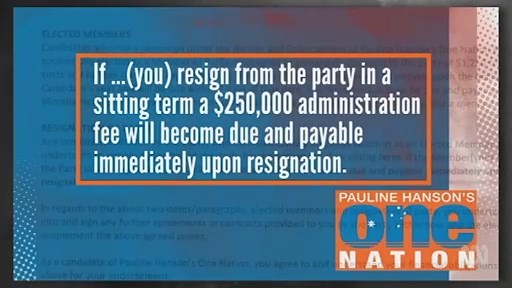
Pauline Hanson's One Nation:
We will bring back federalism and restore Australia’s constitution so that our economy is run for the benefit of Australians instead of the UN and unaccountable foreign bodies that have interfered and have choked our economy since the federal government handed power to the International Monetary Fund in 1944. …
We need to exit the UN.
(Economics & Tax Policy, Accessed 26 June 2017)


(Please Explain, Four Corners, ABC Television, 3 April 2017)


Pauline Hanson (1954)


Pauline Hanson's One Nation Senator for Queensland (2014)

Our common oppressors are a class of raceless, placeless, cosmopolitan elites who are exercising almost absolute power over us: like black spiders above the wheels of industry, they are spinning the webs of our destiny.
(Pauline Hanson and George Merritt, Pauline Hanson — The Truth: On Asian Immigration, the Aboriginal Question, the Gun Debate and the Future of Australia, Saint George Publishing, 1997, p 155)

[I want] multiculturalism abolished. …
A truly multicultural country can never be strong or united. …
[At] this stage that I do not consider those people from ethnic backgrounds currently living in Australia anything but first-class citizens, provided of course that they give this country their full, undivided loyalty. …

I am fed up to the back teeth with the inequalities that are being promoted by the government and paid for by the taxpayer under the assumption that Aboriginals are the most disadvantaged people in Australia. …

The Family Law Act … should be repealed. …

The government should cease all foreign aid immediately …

Between 1984 and 1995, 40% of all migrants coming into this country were of Asian origin.
I believe we are in danger of being swamped by Asians. …
They have their own culture and religion, form ghettos and do not assimilate.

(Maiden Speech, Australian House of Representatives, 10 September 1996)


Now we are in danger of being swamped by Muslims, who bear a culture and ideology that is incompatible with our own.

(Maiden Speech, Australian Senate, 14 September 2016)


John Howard (1939)


25th Prime Minister of Australia (1996 – 2007)

One of the great changes that has come over Australia in the last six months is that people do feel able to speak a little more freely and a little more openly about what they feel.
In a sense the pall of censorship on certain issues has been lifted …
I think there has been a change and I think that's a very good thing.
(Queensland Liberal State Council, 22 September 1996)

By the year 2000, I would like to see an Australian nation that feels comfortable and relaxed about three things:
  • I would like to see them comfortable and relaxed about their history;
  • I would like to see them comfortable and relaxed about the present; and
  • I'd also like to see them comfortable and relaxed about the future.
(Four Corners 55th Anniversary — 1990s, ABC Television, 2016)

… I have to live with the consequences of [the positions I've taken as prime minister,] both now, and into the future.
And, if I ever develop reservations … I hope I would have the grace to keep them to keep them to myself …
(David Marr, His Master's Voice, Quarterly Essay, Issue 26, 2007, p 3)


David Marr (1947)


John Howard [attacked] "black armband" historians and resolutely refused to apologise to the Stolen Generations.
He would stage the Intervention in the Northern Territory as a curtain-raiser for the 2007 election.
This was race politics played by a master.
(The White Queen, Issue 65, March 2017, p 67)

… Howard's government has been the most unscrupulous corrupter of public debate in Australia since the Cold War's worst days back in the 1950s. …
He has a genius for ambiguity [that,] most of the time, keeps [him] just this side of deceit.
But he also lies without shame. …
[He] can admit error, but it is extremely rare.
Apologies are almost unknown.
(p 4)

[Under] Howard, the press has found itself misled, intimidated and starved of information.
On coming to power, Howard set about making sure the tactics he had used so brilliantly to claw down his rivals would not be turned against his government.
There would be minimal tolerance for dissent within the party, the government and the bureaucracy.
The great leaker would stop the leaks.
Senior bureaucrats who survived the purge of the first weeks were instructed to report all calls by journalists to die Prime Minister's press office.
(p 29)

Stories were doled out as rewards.
More than ever under Howard, the press would win access through favourable coverage.
The new communications minister, Richard Alston, was soon lashing the ABC over budgets and bias.
Journalists were locked out of stories - particularly those involving the military and refugees
(p 30)

Canberra has a taste for punishing dissent by cutting off funds.
The Voltaireans of the Cabinet may be willing to sacrifice their lives for the sake of free speech in Australia, but they don't like paying for it. …
Clive Hamilton & Sarah Maddison:
In Australia, recent years have seen an unprecedented attack upon NGOs, most particularly upon those organisations that disagree with the current federal government's views and values.
The attacks have come both from government itself and from close allies such as the Institute of Public Affairs.
Questions have been raised about NGOs' representativeness, their accountability, their financing, their charitable status and their standing as policy advocates in a liberal democracy such as Australia.
(Silencing Dissent, Allen & Unwin, 2007, p 82)
(p 51)

(His Master's Voice, Quarterly Essay, Issue 26, Black Inc, 2007)


George Megalogenis (1964)


Pauline Hanson's timing was immaculately destructive.
(p 279)

[John] Howard couldn't bring himself to declare his outright opposition to Hanson because he felt he was being bullied by the media. …
[Indeed, he] shared the concerns of her supporters about the pace of cultural change.
He didn't see them as racists.
Yet by refusing to put Hanson in her place, Howard created a monster.
(p 280)

[Howard] was the last on his side to stand up to Pauline Hanson.
(p 300)
Paul Keating (1944):
In a nation of immigrants, John Howard let the racism genie out of the bottle. …
[Events like] the Cronulla riot has in its antecedents the notion that somewhere in officialdom at the top of the country it's all right to think poorly of people who come from a different background to yourself.
This is, I think, a dreadful letdown for the country after it had succeeded so greatly in settling so many people from abroad, in perhaps the most successful multicultural experiment in the Western world.
(p 237)

For years [John Howard] had argued against Australia moving before anyone else in the region [to address climate change.]
[Suddenly, in the lead up to the 2007 election,] he wanted to go first …
John Howard (1939):
Australia will … lead internationally on climate change … in a way that builds support for global action to tackle this enormous global challenge. …
[Our's] will be a world-class emissions trading system, more comprehensive, more rigorously grounded in economics and with better governance than anything in Europe.
Implementing an emissions trading scheme and setting a long-term goal for reducing emissions will be the most momentous economic decisions Australia will take in the next decade.
This emissions trading system … needs to last the whole of the twenty-first century if Australia is to meet our global responsibilities and further build our economic prosperity. …
Significantly reducing emissions will mean higher costs for businesses and households, there is no escaping that and anyone who pretends to do otherwise is not a serious participant in this hugely important public policy debate. …
[If] we get this wrong it will do enormous damage to our economy, to jobs and to the economic wellbeing of ordinary Australians, especially low-income households.
(3 June 2007)
(p 319)

[In December 2009, Tony] Abbott repudiated the Coalition's own 2007 election platform …
In a way this was more brazen than the Senate obstruction in the 1970s.
Back then there was an element of principle involved — the Coalition didn't agree with the Whitlam Program.
Abbott was opposing for the sake of it.
No previous opposition had overturned a policy that both sides had agreed to at the previous election. …
Tony Abbott:
[The argument for action on climate change] is absolute crap.
However, the politics of this are tough for us.
80% of people believe climate change is a real and present danger.
(Pyrenees Advocate, October 2009)
(p 349)

Hawke and Howard are Australian triumphalists, who think there is nothing wrong with the nation as it is.
Keating and Fraser are Australian cosmopolitans, who see room for improvement.
(p 4)

The Australian Moment was thirty-five years in the making, starting with
  • the Whitlam government's tariff cut and the formal recognition of China in the early 70s;
  • the Fraser government's termination of the White Australia policy with the entry of the Vietnamese refugees in the second half of the 70s;
  • the Hawke-Keating government economic reforms between 1983 and 1996; and
  • the Howard government's consolidation of those reforms, and the super-charging of the immigration program after 2001.
(p 345)

(The Australian Moment, 2012)

August 24, 2014

Satyajit Das

Green Army: Persons of Interest


Economics is not a science.
At best, it's an ideology.
And, at times, a very dangerous one.


Satyajit Das (1957), The End of Ponzi Prosperity, Big Ideas, ABC Radio National, 23 May 2012.


Jay Gould (1836 – 92) [Financier]:
[The trick is to hire] one half of the working class to kill the other half.
(March 1841)

Kenneth Galbraith (1908 – 2006):
The salary of the chief executive of the large corporation is not a market award for achievement.
It is frequently in the nature of a warm personal gesture by the individual to himself.
(Robert Monks & Nell Minow, Corporate Governance, John Wiley, 2008, p 311)

[Indeed, apart] from the universities … the art of genteel and elaborately concealed idleness may well reach its highest development in the upper executive reaches of the modern corporation.
(The Affluent Society, 4th Edition, Penguin, 1984, p 96)

James Kunstler (1948) [17 October 2005]:
The mortgage industry, a mutant monster organism of lapsed lending standards and arrant grift on a grand scale, is going to implode like a death star under the weight of these nonperforming loans and drag every tradeable instrument known to man into the quantum vacuum of finance that it creates.
(p 203)


The Wizard

[Alan Greenspan was] The Wizard, the man behind the curtain, who mumbled in ways that people couldn't understand, but appeared to be controlling absolutely everything.

David Wessel (1954), The Warning, PBS Frontline, 2009.


Alan Greenspan (1926):
When I agreed to accept the nomination as chairman of [President Reagan's] Council of Economic Advisors, I knew I would have to pledge to uphold … the laws of land, many of which I thought were wrong. …
[Nonetheless,] I had long since decided to engage in efforts to advance free-market capitalism as an insider, rather than as a critical pamphleteer.
(The Age of Turbulence, 17 September 2007)

What we have found over the years in the marketplace is that derivatives have been an extraordinarily useful vehicle to transfer risk:
  • from those who shouldn't be taking it;
  • to those who are willing to, and are capable of doing so.
(Robert Manne, Is Neoliberalism Finished?, Goodbye To All That?, Black Inc, 2010, p 27)

[Government] regulation cannot substitute for individual integrity
[The] first and most effective line of defense against fraud and insolvency is counterparties' surveillance
(Satyajit Das, Extreme Money, p 279-80, emphasis added)

Bernie Madoff (1938):
[In] today's regulatory environment, it's virtually impossible to violate [the] rules …
[This] is something the public doesn't really understand: … it's impossible … for a violation to go undetected — certainly not for a considerable period of time.
(The Future of the Stock Market, Philoctetes, 20 October 2007).


Satyajit Das (1957):
Generally these people are influenced by one of two novels …
  • Tolkien's Lord of the Rings, [or]
  • Ayn Rand's, Atlas Shrugged.
One is a childish fantasy that often engenders a lifelong obsession with its unbelievable heroes; leading to an emotionally stunted, socially crippled adulthood, unable to deal with the real world.
The other, of course, involves orcs.
(The End of Ponzi Prosperity, Big Ideas, ABC Radio National, 23 May 2012)


(Alex Gibney, Enron - The Smartest Guys In The Room, 2005)


(Michael Kirk, The Warning, PBS Frontline, 2009)

Joe Nocera (1952) [Journalist, The New York Times]:
[Alan Greenspan said to Brooksley Born,] something to the effect, that:
[We're] never going to agree on fraud. …
You probably think that there should be rules against it. …
I think the market will figure it out … and take care of the fraudsters.

Michael Greenberger [Director, CFTC, 1997-9]:
Greenspan didn't believe that fraud was something that needed to be enforced …
(Michael Kirk, The Warning, PBS Frontline, 2009)

Commentator:
Alan Greenspan was mistaken …
Creditors can be just prone to greed as the latest wizard of Wall Street [and] they are often the last to understand the risks that would ordinarily help fear counterbalance greed.
(Peter Temple, Hedge Funds: The Courtesans of Capitalism, John Wiley & Sons, 2001, p 282)


(Michael Kirk, The Warning, PBS Frontline, 2009)

Anne Manne:
After a lifetime proselytising on behalf of the "producers" and denouncing anyone needing government assistance as "parasites," when [Ayn Rand] became old and sick, she discovered that even a best-selling author could not afford health care in the neoliberal US.
She [reluctantly] availed herself of Medicare and ended her life on what she had [most] despised — Social Security.
(The Age of Entitlement: How Wealth Breeds Narcissism, The Guardian, 7 July 2014)

John Galbraith (1908 – 2006):
[Economic] insecurity is something that is cherished only for others.
(The Affluent Society, 4th Edition, Penguin, 1984, p 90)