Showing posts with label Persons of Interest. Show all posts

November 21, 2023

Adam Smith

Blue Army: Persons of Interest


All for ourselves, and nothing for anyone else, seems, in every age, to have been the vile maxim of the Masters of Mankind.


Wherever there is a great property, there is great inequality.
For every rich man, you must have hundred poor.
And that rich man must live every time in fear because of the jealousy of others.
And if it is not for the firm hand of the magistrate … he would not be able to keep his capital safe. …
[Civil government,] in so far as it is instituted for the security of property, is in reality instituted for the defense
  • of the rich against the poor, or
  • of those who have some property against those who have none …

The Wealth of Nations, 1779.


Adam Smith (1723 – 90)


The Theory of Moral Sentiments (1759)


[The illusion that the accumulation of possessions brings real satisfaction is the] deception which rouses and keeps in continual motion the industry of mankind. …

The great source of both the misery and disorders and disorders of human life, seems to arise from over-rating the difference between one permanent situation and another …
Some of those situations may, no doubt, deserve to be preferred to others …
[But] none of them can deserve to be pursued with that passionate ardour which drives us
  • to violate the rules either:
    • of prudence, or
    • of justice; or
  • to corrupt the future tranquillity of our minds, either:
    • by shame from the remembrance of our own folly, or
    • by remorse from the horror of our own injustice.

An Inquiry into the Nature and Causes of The Wealth of Nations (1776)


According to the system of natural liberty, the sovereign has only three duties to attend to …
  • the duty of protecting the society from the violence and invasion of other independent societies; …
  • the duty of protecting, so far as possible, every member of the society from the injustice or oppression of every other member of it, or the duty of establishing an exact administration of justice, and …
  • the duty of erecting and maintaining certain public works and … institutions, which can never be for the interest of any individual, or small number of individuals to erect and maintain …

In spite of their natural selfishness and rapacity, [the rich] are led by an invisible hand to make nearly the same distribution of the necessities of life, which would have been made, had the earth been divided into equal portions among all its inhabitants, and thus, without intending it, without knowing it, advance the interest of society, and afford means to the multiplication of the species. …

It is not from the benevolence of the butcher, the brewer, or the baker, that we expect our dinner, but from their regard to their own interest.
We address ourselves, not to their humanity but to their self-love.

(Chapter 2, Book 1)


What are the common wages of labour, depends everywhere upon the contract usually made between those two parties, whose interests are by no means the same.
The workmen desire to get as much, the masters to give as little, as possible.
The former are disposed to combine in order to raise, the latter in order to lower, the wages of labour.

It is not, however, difficult to foresee which of the two parties must, upon all ordinary occasions, have the advantage in the dispute, and force the other into a compliance with their terms.
The masters, being fewer in number, can combine much more easily: and the law, besides, authorises, or at least does not prohibit, their combinations, while it prohibits those of the workmen.

We have no acts of parliament against combining to lower the price of work, but many against combining to raise it.
In all such disputes, the masters can hold out much longer.
A landlord, a farmer, a master manufacturer, or merchant, though they did not employ a single workman, could generally live a year or two upon the stocks, which they have already acquired.
Many workmen could not subsist a week, few could subsist a month, and scarce any a year, without employment. …

Masters are always and everywhere in a sort of tacit, but constant and uniform, combination, not to raise the wages of labour above their actual rate. …
Masters, too, sometimes enter into particular combinations to sink the wages of labour even below this rate.
These are always conducted with the utmost silence and secrecy till the moment of execution …

(Chapter 8, Book 1)


Our merchants and master manufacturers complain much of the bad effects of high wages in raising the price, and thereby lessening the sale of their goods, both at home and abroad.
They say nothing concerning the bad effects of high profits;
  • they are silent with regard to the pernicious effects of their own gains;
  • they complain only of those of other people.

(Chapter 9, Book 1)


No society can surely be flourishing and happy, of which the far greater part of the members are poor and miserable. …

Poverty, though it no doubt discourages, does not always prevent, marriage.
It seems even to be favourable to generation.
A half-starved Highland woman frequently bears more than twenty children, while a pampered fine lady is often incapable of bearing any, and is generally exhausted by two or three.
Barrenness, so frequent among women of fashion, is very rare among those of inferior station.
Luxury, in the fair sex, while it inflames, perhaps, the passion for enjoyment, seems always to weaken, and frequently to destroy altogether, the powers of generation. …

But poverty, though it does not prevent the generation, is extremely unfavourable to the rearing of children.
It is not uncommon, I have been frequently told, in the Highlands of Scotland, for a mother who has born twenty children not to have two alive. …
This great mortality, however will everywhere be found chiefly among the children of the common people, who cannot afford to tend them with the same care as those of better station.
Though their marriages are generally more fruitful than those of people of fashion, a smaller proportion of their children arrive at maturity. …

Every species of animals naturally multiplies in proportion to the means of their subsistence, and no species can ever multiply beyond it.
But in civilized society, it is only among the inferior ranks of people that the scantiness of subsistence can set limits to the further multiplication of the human species; and it can do so in no other way than by destroying a great part of the children which their fruitful marriages produce. …

The liberal reward of labour, by enabling them to provide better for their children, and consequently to bring up a greater number, naturally tends to widen and extend those limits.
It deserves to be remarked, too, that it necessarily does this as nearly as possible in the proportion which the demand for labour requires. …
It is in this manner that the demand for men, like that for any other commodity, necessarily regulates the production of men,
  • quickens it when it goes on too slowly, and
  • stops it when it advances too fast.
It is this demand which regulates and determines the state of propagation in all the different countries …

The liberal reward of labour, therefore, as it is the effect of increasing wealth, so it is the cause of increasing population.
To complain of it, is to lament over the necessary cause and effect of the greatest public prosperity.

(Chapter 10, Book 1)


The man whose whole life is spent in performing a few simple operations … generally becomes as stupid and ignorant as it it is possible for a human creature to become.
The torpor of his mind renders him not only incapable of relishing or bearing a part in any rational conversation, but of conceiving any generous, noble, or tender sentiment …
Of the great and extensive interests of his own country he is altogether incapable of judging …

(Part 2, Chapter 10, Book 1)


All for ourselves, and nothing for anyone else, seems, in every age, to have been the vile maxim of the Masters of Mankind.

(Chapter 4, Book 3)


The proposal of any new law or regulation of commerce which comes from [the business elite] ought always to be listened to with great precaution, and ought never to be adopted till after having been long and carefully examined, not only with the most scrupulous, but with the most suspicious attention.
[For it] comes from an order of men,
  • whose interest is never exactly the same with that of the public,
  • who have generally an interest to deceive and even to oppress the public, and
  • who accordingly have, upon many occasions, both deceived and oppressed it.

[The individual] is in this, as in many other cases, led by an invisible hand to promote an end which was no part of his intention. …
I have never known much good done by those who affected to trade for the public good.
It is an affectation, indeed, not very common among merchants, and very few words need be employed in dissuading them from it.

(Chapter 2, Book 4)


Wherever there is a great property, there is great inequality.
For every rich man, you must have hundred poor.
And that rich man must live every time in fear because of the jealousy of others.
And if it is not for the firm hand of the magistrate … he would not be able to keep his capital safe. …
[Civil government,] in so far as it is instituted for the security of property, is in reality instituted for the defense
  • of the rich against the poor, or
  • of those who have some property against those who have none …

The subjects of every state ought to contribute towards the support of the government, as nearly as possible, in proportion to their respective abilities; that is, in proportion to the revenue which they respectively enjoy under the protection of the state.

(Part 2, Chapter 2, Book 5)

October 19, 2023

Devon Price

Green Army: Persons of Interest


Devon Price


Autism Activist.
Professor of Social Psychology.

  • How "unmasking" leads to freedom for autistic and other neurodivergent people, Life Kit, NPR, 18 April 2022.
  • Unmasking Autism: Discovering the New Faces of Neurodiversity, 2022.

    Autism: From Disorder to Oppression


    Price reconceptualizes autism in three stages:
    1. Demedicalization: from disorder to difference.
    2. Identitarianism: from difference to identity.
    3. Politicization: from identity to oppression.

    Price accepts that the central problem in autism is in the domain of social communication and interpersonal functioning.
    What he rejects is that this due to an impairment or deficits in the capacity for verbal or non-verbal communication and social cognition.
    Price's frames autism as a normal human variant with a different cognitive / communication style.
    It is this mismatch of styles, he asserts, that accounts for the interactional problems between autistics and non-autistics.
    Devon Price:
    Autism is neurological.
    Autism is a developmental disability that … appears to be largely genetically heritable …

    [Much] of what researchers consider the “social deficits” of Autism aren’t really deficits at all; they’re just differences in our communication style that neurotypicals don’t adjust to. …
    Autistic people don’t actually lack communication skills, or a drive to connect. …

    [The] idea of pursuing a treatment “for” Autism is predicated on the idea we are broken or sick … an idea the neurodiversity movement completely rejects. …
    Where the medical model of disability fails is in making sense of disabilities that come from social exclusion or oppression. …

    [We] are disabled, robbed of empowerment and agency in a world that is not built for us. …
    The world actively dis-ables people by failing to provide accommodations they need.
    Naming the reality of disability shows respect for disabled people and awareness of how we are oppressed. …

    [Neurotypicality] is more of an oppressive cultural standard than it actually is a privileged identity a person has. …
    [There] are just so many ways in which we are punished for deviating from the norm. …
    Ableism is a pervasive social force, and one we can’t entirely escape …
    The criminal justice system and mental health system are deeply interwoven, and they both serve to perpetuate ableism.
    Ableism is a powerful force of oppression. …

    Almost every person with a mental illness or disability … has repeatedly tried and failed to earn acceptance by playing the rules of a game that was designed to harm us. …
    Being Autistic in a neurotypical world is often traumatizing, and being forced to mask is essentially an experience of society-driven abuse.…
    [Your] disability isn’t to blame for what happened, and neither are you.
    It was a far-reaching, centuries-old system of injustice that left you in such a difficult spot. …

    Almost anyone can be viewed as defective or abnormal under our current medicalized model of mental illness …
    By tearing down our current, constricting definition of mental health, and celebrating different ways of thinking, feeling, and behaving, we can improve countless lives. …
    Our caring professionals and educators must be made aware … that their prejudicial attitudes often create disability where none might otherwise be there. …

    When we teach children about racism, sexism, and imperialism throughout history, we should highlight how the oppressed were often branded as hysterical, paranoid, and insane.
    It’s important that all people — neurodiverse and neurotypical alike — come to realize how narrow definitions of sanity and “functioning” are used to harm and dehumanize.
    Price's conceptualization of disability is most easily understood by examining the ways in which it departs from the standard biopsychosocial model of disability as described in the public health literature:
    As the diagram indicates … disability and functioning are viewed as outcomes of interactions between health conditions (diseases, disorders and injuries) and contextual factors.

    Among contextual factors are
    • external environmental factors (for example, social attitudes, architectural characteristics, legal and social structures, as well as climate, terrain and so forth); and
    • internal personal factors, which include gender, age, coping styles, social background, education, profession, past and current experience, overall behaviour pattern, character and other factors that influence how disability is experienced by the individual.
    (Concepts of functioning and disability, Towards a Common Language for Functioning, Disability and Health: The International Classification of Functioning, Disability and Health, 2002, p 10)

    So the standard view of disability is that it results from an interaction between individual impairment (due to a disease or disorder) and environmental conditions.
    The archetypal example someone in a wheelchair being disabled due to the absence of wheelchair access.
    The impairment is an inability to walk.
    The disability is due to impairment (due to some disease or disorder) interacting with an external environmental factor (eg a lack of accessibility).
    No impairment (ie no disorder), no disability.
    If there is impairment, whether or not there is associated disability may depend on environmental conditions (eg ramps).


    In contrast with mobility, is it likewise possible that a neurologically based social ineptitude could be severe enough to cause significant psychosocial impairment?
    The scientific community says yes.
    Price says no: autism does not cause impairment, therefore it is not a disorder.


    In what sense, then, is autism a disability?
    Here Price draws a distinction between impairment related (medical) disability and non-impairment related (social) disability; arguing that autism is a social / political / cultural / normative disability, not a medical disability.
    And the source of this social disability?
    Ablelist / neurotypical oppression.
    Though, if Price is correct about the lack of impairment, this cannot, strictly speaking, be 'ablelist' in the usual sense of the word.
    Ablelism is discrimination based on actual medical impairment.
    Since, for Price, there is no impairment in autism, one would need to expand the meaning of ableism to include the false imputation of impairment where none exists, then stigmatizing autism based on this mislabeling.
    So, these semantic contortions leave us with two novel senses of 'disability' and of 'ablelism'.


    In summary, neurotypical oppression leads to social disability based on a biological difference between non-autistics and autistics (or alternatively between the neurotypical and the neurodiverse), not a difference between health and disorder, but a difference between two normal human developmental variants.
    The source of the disability is not individual disorder / impairment but the prevailing system of oppressive societal norms.
    Ableism dis-ables autistics in the same way as slavery dis-ables the enslaved.
    According to this view autistics are being compelled to conform to unjust cultural standards only to be excluded when they (inevitably) fail.


    What are the difficulties of this theory?
    To describe severe autistics, those without language, unable to attend to their own basic self-care and protection, as being normal developmental variants, seems to deny an obvious reality, hiding it behind a screen of confusing language and political ideology.
    In any other context — perinatal anoxia, traumatic brain injury, disabling genetic syndromes — such reduced capabilities would be regarded as major psychosocial impairments .
    They require intensive professional (ie formal) assistance and support.


    Consider the definition of mental disorder:
    Mental_disorder:
    A mental disorder … is a behavioral or mental pattern that causes significant distress or impairment of personal functioning.
    (Wikipedia, 18 September 2023)
    One might add that by 'significant' is meant severe enough to be the focus of clinical / research attention ie professional (formal) intervention as distinct from subclinical, which is manageable by informal supports (self-help, peer-support, life-coaching, personal development).
    That is to say, those who fall below the clinical threshold of severity do not have a disorder in the sense of requiring formal assistance.
    Whether the 'challenges' of this population are primarily due to systematic oppression, as Price contends, is debatable.
    While there is overlap between the concepts of oppression, stigmatized difference, and discrimination, they are not the same thing and are not freely interchangeable.


    The mind-body distinction plays a role here.
    Certain physical problems, like a broken bones, are not stigmatized.
    Communicable diseases on the other hand are stigmatized, for obvious reasons.
    Problems with the brain, affecting mind and behavior, are more closely linked with moral personhood.
    Mental dysfunction naturally bleeds over into adverse judgements of the self.


    Price's seeks to demedicalize autism (presumably) in order to destigmatize it.
    Because he takes an identitarian approach to autism, demedicalization is necessary because it is unacceptable to identify with a stigmatized entity.
    If autism is identified with the self, and autism is a disorder, then the self is disordered.
    And the self has to be defended at all costs.
    There's nothing wrong with me, society's to blame.
    It's not me that needs to be fixed, but the world.
    One can address medical stigma directly, or as in Price's case, indirectly, by denying one has a disorder so as to avoid the associated stigma.
    The alternative is to directly address the stigmatizing of illness in general, and developmental disorder in particular.


    This identitarianism is expressed in the preference for disability-first over person-first terminology:
    • being an Autistic person vs a person with autism,
    • being an schizophrenic person vs a person who suffers from schizophrenia,
    • being an Asian person vs being a person of Asian descent,
    • being a gay person vs being a person who is same sex attracted.
    Identitarianism invites essentialist thinking.
    In the area of race this is especially dangerous.
    Defining people by their ethnicity is the foundation of biological racism.
    It essentializes ethnicity and conflates linguistic and cultural identity with biological descent.
    There are numerous diasporas where immigrants are fully integrated with the majority culture despite differences in physical appearance.
    One is not defined by one's ancestry any more than one is defined by one's neurology.
    Benjamin Zachariah [Historian]:
    Once upon a time, essentializing people was considered offensive, somewhat stupid, anti-liberal, anti-progressive, but now this is only so when it is done by other people.
    Self-essentializing and self-stereotyping are not only allowed but considered empowering.
    (After the Last Post: The Lives of Indian Historiography, 2019)


    Devon Price:
    [It’s] more sensible to view Autistic identity through a social lens than a strictly medical one. …
    [The] social model of disability, originally coined in the 1980s by disabled academic [sociologist] Mike Oliver.
    In his writing, Oliver described disability as a political status, one that is created by the systems that surround us, not our minds and bodies.
    While it is true that Oliver sought to draw attention to the environmental factors contributing to disability it seems he did not believe these were the only factors involved.
    That he distinguished between impairment and disability indicates he did believe that impairments existed and played a role in disability.
    As originally conceived, the social model of disability was a model of impairment-related disability, not a social model (or lens) of identity.
    Social model of disability:
    The social model of disability diverges from the dominant medical model of disability, which is a functional analysis of the body as a machine to be fixed in order to conform with normative values. …
    In this model, the word impairment is used to refer to the actual attributes (or lack of attributes) that affect a person, such as the inability to walk or breathe independently.
    It seeks to redefine disability to refer to the restrictions caused by society when it does not give equitable social and structural support according to disabled peoples' structural needs. …

    Oliver did not intend the social model of disability to be an all-encompassing theory of disability, but rather a starting point in reframing how society views disability.
    This model was conceived of as a tool that could be used to improve the lives of disabled people, rather than a complete explanation for every experience and circumstance.

    A primary criticism of the social model is its centering of the experiences of individuals with physical impairments, which has resulted in overlooking other forms of disability, such as mental health conditions. …

    In the late 20th century and early 21st century, the social model of disability became a dominant identity for disabled people in the UK.
    Under the social model of disability, a disability identity is created by:
    • "the presence of impairment,
    • the experience of disablism, and
    • self-identification as a disabled person."
    (Wikipedia17 September 2023)

    In addition to with arguing that autism is not a disorder, Price also criticizes the syndromic approach to diagnosis in general, at least when it is applied to conditions whose manifestations are 'mental' (psychological or behavioral), rather than 'physical' (neuropathic pain).
    Again, he concedes that autism has a physical cause, but not that it is a disorder.
    Devon Price:
    [For] many illnesses and disabilities, medical care and a medical lens is undeniably appropriate.
    If you’re someone who is in excruciating, daily pain due to nerve damage, medical treatment and medication can help you.
    If you have a degenerative condition that progressively gets worse, such as multiple sclerosis, you have every reason to support medical research in pursuit of a cure. …

    [It’s] arguable whether the disability should even be defined by the presence of clear behavioral signs, such as
    • trouble reading social cues or
    • hesitating to initiate contact with other people. …
    Instead of looking to the external signals of autism that others might pick up on, it’s important that we instead focus on
    • the neurobiological markers of the neurotype, and
    • the internal experiences and challenges that Autistic people themselves report. …
    [Autism is] diagnosed based on behavior and reported challenges the Autistic person is facing, not on a brain scan. …

    When it comes to mental illness and disability, diagnostic categories are really flawed things.
    A disorder is a cluster of symptoms and traits that tend to go together, but don’t always, and the way those clusters get organized tends to change over time. …
    Our understandings of these labels are constantly in flux, and who gets stuck with a particular label varies across time and cultural context. …
    This dynamic is particularly challenging for people with Autism Spectrum traits, because our neurotype is so multifaceted and so easily mistaken for other conditions. …

    I prefer the terms self-determination or self-realization to self-diagnosis, because I believe it’s more sensible to view Autistic identity through a social lens than a strictly medical one.
    Diagnosis is a gatekeeping process, and it slams its heavy bars in the face of anyone who is too poor, too busy, too Black, too feminine, too queer, and too gender nonconforming, among others. …

    [Self-definition] is a means of reclaiming our power from the medical establishment that has long sought to corral and control us.


    Neurotype:
    A type of brain, in terms of how a person interprets and responds to social cues, etc.
    • 2018, Steve Bloem, The Pastoral Handbook of Mental Illness, page 56:
      And the neurotypes aren't random.
      They align with their symptom clusters along two major axes: anxiety and anhedonia (the inability to feel pleasure).
    (Wiktionary, 23 April 2023)

    ('Neurotype' does not yet appear in OED online)
    If you reject expert opinion using on objective criteria (syndromal diagnosis based on patterns of signs and symptoms), how do you determine your neurotype?
    Is it something you knows instinctively, like same sex attraction?
    Do you conclude you are Autistic because you feel an affinity with others who identify as Autistic?
    How did they discover they were Autistic?
    Is it all about identification:
    • gender: male / female / non-binary?
    • race: black / white / colored?
    • neurotype: neurotypical / neurodiverse?

    There are no 'neurobiological markers of the neurotype'.
    There is no neuroscience or recognized classification of neurotypes.
    There are only neurobiological correlates of known clinical syndromes.
    Substituting the word 'neurotype' for 'diagnosis' is just trying to demedicalize autism by linguistic manipulation.
    This is no substitute for a rational debate about alternative ways of categorizing phenomena.
    Like using the word 'disability' in a non-impairment-related (social) sense, when in common usage it refers to disability in the impairment-related (medical) sense.
    Unless done carefully, argument by redefinition just creates confusion.


    Since it is unclear what the general properties of a neurotype are, one cannot be certain what entities should be included in this category.
    Is anyone who is neurodiverse (ie not neurotypical), possessed of a neurotype?
    Where do temperaments and personality traits fit in?
    Price mentions both:
    • a range of specific conditions apart from autism: Tourettes, ADHD, PTSD, depression, schizophrenia, epilepsy, and Social Anxiety Disorder; as well as
    • certain general categories: Mental Illness / Disorder and Cognitive Disability (TBI, CTE, dementia, ID).
    Clearly many putative neurotypes are neither congenital / developmental nor permanent / unchangeable as Price asserts autism is.
    Many with PTSD were neurotypical before being traumatized, and some recover.
    Likewise, in a significant proportion of cases schizophrenia, depression, and epilepsy are not permanent conditions.


    Price's perspective echos a range of past and current intellectual traditions:

    1. Demedicalization:

      R D Laing:
      Laing took the expressed feelings of the individual patient or client as valid descriptions of personal experience rather than simply as symptoms of mental illness. …
      Laing regarded schizophrenia as the normal psychological adjustment to a dysfunctional social context, but he later acknowledged that his views on schizophrenia were wrong.
      (Wikipedia, 24 September 2023)

      Labeling Theory:
      Labeling theory holds that deviance is not inherent in an act, but instead focuses on the tendency of majorities to negatively label minorities or those seen as deviant from standard cultural norms.
      (Wikipedia, 26 September 2023)

    2. Identitarianism:

      Devon Price:
      … I capitalize “Autistic” … to indicate it is a part of my identity I am proud of, and to signal Autistics have our own culture, history, and community. …
      Because the neural and cognitive features of autism are so pervasive, it affects almost every aspect of a person’s body and brain. …
      autism is a core part of who we are, impossible to separate from our personalities, talents, preferences, and general outlook. …
      Without our disability (or our gender identity) we’d be entirely different people.
      They’re both core parts [of our personhood or personality …]


      Neurodiversity:
      The framework grew out of the autism rights movement and builds on the social model of disability, arguing that disability partly arises from societal barriers, rather than attributing disability purely to inherent deficits.
      It instead situates human cognitive variation in the context of biodiversity and the politics of minority groups.
      Some neurodiversity advocates and researchers argue that the neurodiversity paradigm is the middle ground between strong medical model and strong social model.
      The neurodiversity paradigm has been controversial among disability advocates, with opponents arguing it risks downplaying the suffering associated with some disabilities, and that it calls for the acceptance of things some would wish to be treated.
      (Wikipedia, 26 September 2023)


      Identity Politics:
      Many contemporary advocates of identity politics take an intersectional perspective, which accounts for the range of interacting systems of oppression that may affect their lives and come from their various identities.
      According to many who describe themselves as advocates of identity politics, it centers the lived experiences of those facing systemic oppression; the purpose is
      • to better understand the interplay of racial, economic, sex-based, and gender-based oppression (among others) and
      • to ensure no one group is disproportionately affected by political actions, present and future.
      Such contemporary applications of identity politics describe people of specific race, ethnicity, sex, gender identity, sexual orientation, age, economic class, disability status, education, religion, language, profession, political party, veteran status, recovery status, and geographic location.
      These identity labels are not mutually exclusive but are in many cases compounded into one when describing hyper-specific groups.
      (Wikipedia, 14 August 2023)

    3. Politicization:

      • sexism — discrimination / oppression based on patriarchy (eg the feminist 'male gaze' recast as the 'neurotypical gaze');
      • biological racism — discrimination / oppression based on imagined biological differences between races;
      • homophobia — discrimination / oppression based on sexual taboos;
      • ableism — discrimination / oppression on physical or mental impairment.

      Kenneth Minogue:
      Ideology is commonly signaled by the presence of a tripartite structure of theory.
      The first stage reveals to us that the past is the history of the oppression of some abstract class of person.

      It is concerned
      • with workers as a class, not (as a politician might be) with workers at a particular time and place; or
      • with women in general, or
      • with this or that race.
      Specific discontents are all swept up into the symptomatology of the structurally determined oppression.
      The duty of the present is thus to mobilize the oppressed class in the struggle against the oppressive system.
      This struggle is not confined to the conventional areas of politics.
      It flares up everywhere, even in the remoter recesses of the mind.
      And the aim of this struggle is to attain a fully just society, a process generally called liberation.
      Ideology is thus a variation played on the triple theme of oppression, struggle, and liberation.
      (Politics: A Very Short Introduction, Oxford University Press, 1995)

April 24, 2022

Simon Chapman

Green Army: Persons of Interest


I am a cigarette with a life attached.

Raymond Carver (1938 – 88)

Simon Chapman (1951)


Smoking kills 19,000 Australians a year, more than 4,000 before retirement age, more than those who die from breast, cervical and skin cancer, AIDS, suicide, alcohol and road crashes combined.
(p 192)

Globally, an estimated 4 million people die each year from tobacco-related illness, compared to 2.7 million from malaria and 2.8 million from AIDS.
After malnutrition (5.9 million in 1990) and violence and injury (5.8 million), tobacco claims more deaths than any other single cause.

(Smoke Signals, 2016, p 141)


Simon Chapman [Director of Research, School of Public Health, University of Sydney]:
[According to] internal tobacco industry documents [the price of cigarettes] is the single greatest determinant of smoking in the community. …

[They also] show that the main purpose of [cigarette additives] is to make smoking more palatable for young people.
[A] lot of work has gone [into reducing] 'throat grab' [‒ that initial coughing you get when you first start smoking.]
[Menthol] acts as a sort of a gentle local anaesthetic in the throat, which makes [smoking] easier, particularly for young women, who tend to favour menthol cigarettes …

Robert Proctor:
[Smoking] is not like drinking …
[It's] like being an alcoholic.
Only about three per cent of people who drink are addicted, whereas 80 to 90 per cent of people who smoke are addicted. …
[Smoking] is not a recreational drug …

[The] cigarette pack itself [is] the last bastion of advertising.
The cigarette pack [is] like a micro-ad …
[Cigarettes are an undifferentiated product, they're] basically all … the same.
[From a marketing viewpoint, the packaging is the] product. …

Simon Chapman (1951):
[If you] open any tobacco industry trade magazine [there is] page after page of advertisements from packaging companies, talking about how packaging is front and centre of branding …
[The package] is the centre of the advertising effort.

There's been a lot of experimental evidence by people showing young people different versions of packs and asking them which ones that they would prefer.
[They] always say that they don't like the plain-packaged ones, they want the nice looking packs …
[It's] a no-brainer.
[The] next generation of kids will grow up never having seen a packet of carcinogenic products packaged in a beautiful box.

(Plain packaging of cigarettes, ABC Rear Vision, 19 October 2011)

Would you like to know more?


E-cigarettes


Banks E, Yazidjoglou A, Brown S, Nguyen M, Martin M, Beckwith K, Daluwatta A, Campbell S & Joshy G

Among non-smokers, there is currently strong evidence that use of e-cigarettes is harmful to health overall, with multiple health harms and no health benefits identified in this population. …
There is no available evidence as to how e-cigarette use affects clinical mental-health outcomes. …
There is strong evidence that e-cigarettes increase combustible smoking uptake in non-smokers, particularly youth …

Use of e-cigarettes results in inhalation of a complex array of chemicals originating from:
  • the e-liquid,
  • chemical reactions in the heating coil and the device itself.
These include:
  • nicotine,
  • solvent carriers (propyleneglycol, ethylene glycol and glycerol),
  • tobacco-specific nitrosamines,
  • volatile organic compounds,
  • phenolic compounds,
  • flavourings,
  • tobacco alkaloids,
  • aldehydes,
  • free radicals,
  • reactive oxygen species,
  • furans, and
  • metals.
Toxicological studies indicate that exposure to these substances can result in adverse health effects. Nicotine is highly addictive and there is evidence from basic human and animal studies that it adversely affects:
  • cardiovascular measures, and
  • brain development and functioning. …
Nicotine e-cigarettes are highly addictive, underpinning increasing and widespread use among children and adolescents in many settings. …

There is conclusive evidence that:
  • e-cigarettes and their constituents cause poisoning, injuries and burns and immediate toxicity through inhalation, including seizures …
  • their use leads to addiction, and that
  • they cause less serious adverse events, such as throat irritation and nausea.
There is conclusive evidence that the use of e-cigarettes can cause [EVALI (e-cigarette or vaping product use-associated lung injury)] among smokers and non-smokers … with
  • half of cases related to THC in conjunction with vitamin E acetate, and
  • 14% in patients reporting the use of nicotine-delivering products only …

(Executive Summary, Electronic cigarettes and health outcomes: systematic review of global evidence, Report for the Australian Department of Health, National Centre for Epidemiology and Population Health, Canberra, April 2022, pp viii‒xiv, emphasis added)


Wind Turbines


There is currently no published scientific evidence to positively link wind turbines with adverse health effects. …
The evidence on shadow flicker does not support a health concern. …
[Wind] turbines of contemporary design … produce very low levels of infrasound. …
The risk of blade glint from modern wind turbines is … very low.
[The] closeness of the electrical cables counters the electromagnetic field [generated by wind turbines], as does shielding with metal armour. …
[Evidence is limited, therefore] it is recommended that relevant authorities take a precautionary approach and continue to monitor research outcomes.

(NHMRC Public Statement, July 2010)


Table 3 (Adapted): Typical A-weighted sound levels for different sources

ActivitySound pressure level (dBA)
Busy general office60
Car travelling at 64km/h at 100m55
Typical wind farm (at moderate wind speed 7 m/s)*40 ± 5
Background noise in rural area at night30 ± 10
*Based on sound level measurements taken from multiple resident locations near two Victorian wind farms, at distances 500–1,000 m from the nearest turbine.

(p 8)

July 4, 2021

Gigi Foster

Blue Army: Persons of Interest


An Epidemic of Socialism

COVID didn't crush the economy.
Government crushed the economy.


Kristi Noem (1971), Govenor of South Dakota, CPAC, 2021.


[You] need to control the virus to get people back to work.

Alan Kohler (1952)


(ABC News, 2 September 2020)


(ABC News, 7 December 2020)


Liberty Or Death

(Pandemic 2020)


Gigi Foster


Associate Professor of Economics, UNSW Business School.
PhD (Economics), University of Maryland.
BA (Ethics, Politics, and Economics), Yale University.


Are Lockdowns a Crime Against Humanity?


The Nuremberg code [is] a code of ethical standards …
It's something that, essentially, the war criminals of period during the WWII atrocities were facing, in the 1950s kind of period, to try to draw them to account for the massive damage they had done, the genocides.
And this code is something that requires governments defend the actions on the basis of public health.
So the sixth Nuremberg code demands that the decision maker must have a reasonable view that the benefits of an intervention will be higher than the costs, and failure to abide by that is a crime against humanity …
Museum Note:
On August 19, 1947, the judges of the American military tribunal in the case of the USA vs Karl Brandt et al … confronted the difficult question of medical experimentation on human beings. …
Although the [Nuremberg] code addressed the defense arguments in general remarkably none of the specific findings against Brandt and his codefendants mentioned the code.
Thus the legal force of the document was not well established.
The uncertain use of the code continued in the half century following the trial when it informed numerous international ethics statements but failed to find a place in either the American or German national law codes.
Nevertheless, it remains a landmark document on medical ethics …

Permissible Medical Experiments:
The degree of risk to be taken should never exceed that determined by the humanitarian importance of the problem to be solved by the experiment.
(Nuremberg Code, United States Holocaust Memorial Museum)
Have you seen a cost-benefit analysis produced by the government to defend its decisions during this period?
To strip people of their liberties.
To close schools.
To shut borders.
To cease trade.
I went for months waiting for that and finally produced one on the back of a cocktail napkin basically myself [in approximately … 15 hours in August 2020.]

[You can't assume] that it was those tough early restrictions that, as a package, created the outcomes we've seen.
My reading of the data is that pretty much how well or not you did in this period health-wise and economics-wise was kind of unrelated whether you locked down really hard or not so hard or whatever.
In fact the best thing to do probably would have been to target of our protection and our attention to the people who were actually vulnerable to this virus, and to invest in things like prophylactic treatments evaluation and evaluation of what can we do, medicines we can use, not just vaccines, but all sorts of cheaper things, when somebody gets the virus to prevent them getting serious symptoms. …

[We're] an island nation …
But there are many [other] reasons why the virus didn't run like it did, in the US for example, here that have nothing to do with our policy responses and you can compare Victoria to NSW if you want to get a sense of what's possible without locking down. …


[We] knew that this thing was killing mainly older people … which is why … in March of last year I called for the radical protection of older people, people in danger from this virus, and everybody else be allowed to go about their business as they deemed fit …
And the thing is, it's very uncomfortable right now to admit that we messed up.
For the politicians to admit it …

(Lockdowns and the path forward , ABC The Economists, 24 June 2021)


If you look at the people who have died from [COVID-19, they] have 5-6 years on average still to live …
How much does a developed society typically spend in normal times per [Quality Adjusted Life Year?]
Usually somewhere between $50,000 and $150,000 per QALY. …
Office of Best Practice Regulation:
Willingness to pay is the appropriate way to estimate the value of reductions in the risk of physical harm – known as the value of statistical life.
Based on international and Australian research a credible estimate of … the value of statistical life year is $195,000 in 2018 dollars.
(Best Practice Regulation Guidance Note: Value of statistical life, Department of the Prime Minister and Cabinet, Australian Government, October 2018)

William Viscusi (1947):
Unlimited personal freedoms will lower our well‐being, particularly when confronting crises for which collective, responsible behavior is desirable.

Mortality costs of COVID‐19 in Australia as of January 1, 2021
(Table A1 extract)
Number of deaths909
VSL ($ millions)8.6636
VSL × deaths ($ millions)7875
VSL = Value of a Statistical Life

(Economic lessons for COVID‐19 pandemic policies, South Economic Journal, 4 March 2021)
[So] every death we [prevent] from COVID-19 is [worth] around $500,000 and $600,000. …
Then you have a currency. …
Then you can say … when we do this lockdown:
  • [Firstly,] are we actually preventing that many more deaths?
  • [Secondly,] whatever number we are saving [we] multiply that by whatever the amount is we're willing to spend in normal times to save that amount of lives, that quality of life.
[Then] we get a dollar figure.
And then we can say: …
Is the economic cost of implementing these measures less than that?
  • [If] so — good idea.
  • If not — let's think about it more.
(Who'll pay the COVID-19 bill?, ABC The Signal, 5 May 2020)


What Have The Capitalists Ever Done For Us?


[Shutdowns are] very much a cure that's worse than the disease …
We had Trump saying that, by Easter, he wants things to be back on game …
He's right … to try to give a stopping point, to try to increase a bit of certainty about what to expect.
Because businesses … are in free freefall — people are stressed and they're going to be dying from that at some stage. …

This is the way that economies in communist systems organise …
[Whereas, Capitalism] has kept us all doing so well and having such luxurious lives, by historical and international comparisons, for so long. …

We know GDP is a huge predictor of [longevity.]
[Life] spans have increased over the last 100 years … on the back of rises in GDP per capita that pay for research and development, and health … and education services, and better roads, and everything that makes our lives better …
We giving that up with every day we are in shutdown …

[The global response to COVID-19] is actually killing people …
I'm talking about statistical lives lost.
Human welfare which is tanking because the economy is tanking. …

[Keeping the economy running] saves many more lives than are saved by quarantining the entire economy …
[The tradeoff is] not lives against money, it's lives against more lives. …

We need to be aggressively targeting isolation of older people, because those are the people who are dying. …
But to say to young people you should stay home and worry, and not go to pubs, is … absolutely a disgrace.
[These people] won't die from it — under 40 it's a 0.2% death rate …
[When Boris Johnson] could not stay that ["herd immunity"] course in the face public opinion — that was an entirely political move. …


The young people who lived through this, the coronavirus cohort, they are going to see negative effects throughout their lives because of what has already happened.
The longer this goes on, the worse off those people are going to be, 10 years, 20 years, 30 years …

I just want to see us open for business as soon as possible.

(As the coronavirus marches on, can wartime measures save us from a depression?, ABC The Economists, 26 March 2020)

November 25, 2019

John Quiggin

Green Army: Persons of Interest


[The] culture wars are just a device to keep the right-wing base agitated enough to turn out [and] keep pro-rich politicians in office. …
The great majority of [climate change] “sceptics” are, in fact, credulous believers in what they are told by trusted authority figures, notably including conservative political leaders.


Climate claims a victory in the culture wars, Inside Story, 17 December 2015.


The Global Financial Crisis has shown that, for most of the past decade, market estimates of the relative riskiness and return of alternative investments have been entirely unrelated to reality. …

In Australia … it has become routine for retired politicians, of all political persuasions, to be offered cushy jobs in the financial sector, provided, of course, that they have followed the right kinds of policies when in office. …
Public office is no longer a goal in itself but a stepping stone to bigger and more profitable goals.
The incentives to promote the interests of the financial sector while in office are obvious. …

An analysis by the New Economics Foundation concluded that for each pound paid to British bankers, society incurred a net loss of ten pounds. …
A study by the Center for Responsive Politics showed that about two-thirds of US senators were millionaires in 2008.


— Zombie Economics, Princeton University Press, 2012, pp 190, 186, 174-5.


Traditional models of on-the-job training (apprenticeships and traineeships) are in decline.
Funding for vocational education through the Technical and Further Education (TAFE) system has been slashed leading to the closure of manyTAFEs and large-scale loss of teaching staff.
Meanwhile, billions of dollars have been wasted on ideologically driven experiments with market competition and forprofit provision.


— Submission to the South Australian Senate inquiry into Vocational Education and Training.

October 11, 2019

Jordan Peterson

Blue Army: Persons of Interest


God the Father


Order, the known, appears symbolically associated with masculinity …
This is perhaps because the primary hierarchical structure of human society is masculine, as it is among most animals …
It is because men are, and throughout history have been,
  • the builders of towns and cities,
  • the engineers, stonemasons, bricklayers, and lumberjacks,
  • the operators of heavy machinery.
Order is:
  • God the Father, the eternal Judge, ledger-keeper and dispenser of rewards and punishments. …
  • the peacetime army of policemen and soldiers. …
Chaos, the eternal feminine, is … the crushing force of sexual selection.


Jordan Peterson (1962), 12 Rules for Life, 2018.


Fascists did not value masculinity per se – only that of some male members of the dominant race.
Socialists and communists (despite their own macho inclinations) were seen as the fomenters of ‘feminine’ indiscipline – while the fascist revolution was characterized by manly order.
The Nazis saw the Jews and Poles as ‘feminine’ races, achieving their goals through devious plots rather than masculine openness.


— Kevin Passmore (1962), Fascism: A Very Short Introduction, 2002.


[The] Western subjugation of the female is … a function of biblical thinking.

Joseph Campbell (1904 – 87), Love and the Goddess, The Power of Myth, Episode 5, 1988.


[Even] the most thoughtful and fair-minded of [men] fall back on conservative assumptions about the inevitability of present:
  • gender relations, and
  • distributions of power,
calling on precedent or sociobiology and psychobiology to demonstrate that male domination is natural and follows inevitably from evolutionary pressures.


Peggy McIntosh (1934), White Privilege and Male Privilege, 1988.


Biology is Destiny

Maybe it is more important to strengthen our characters than to repair the world.
So much of that reparation … is selfishness and intellectual pride masquerading as love, creating a world polluted with good works that don’t work. …

This idea — granted me by the grace of God — allowed me to believe that I could find what I most wanted …

All cultures … have, within their mythological history, certain constant features … just as all languages share grammatical structure …
  • The lines among which culture develops are determined biologically, and
  • the rules which govern that development are the consequence of the psychological expression of neurophysiological structures. …

Mythological renditions of history, like those in the Bible, are just as "true" as the standard Western empirical renditions, just as literally true, but how they are true is different.
  • Western historians describe (or think they describe) “what” happened.
  • The traditions of mythology and religion describe the significance of what happened …

I think I have discovered something that no one else has any idea about …


— The Divinity Of Interest, Maps of Meaning, 1999.


Look for your inspiration to the victorious lobster, with its 350 million years of practical wisdom.
Stand up straight, with your shoulders back.


Jordan Peterson (1962), 12 Rules for Life, 2018.


[The] fact that intuitive responses are widely held is not evidence that they are justified.
They are not rational insights into a realm of moral truth.
Some of them — roughly, those that we share with others of our species, irrespective of their cultural background — are responses that, for most of our evolutionary history, have been well suited to the survival and reproduction of beings like us.
Other intuitive responses — roughly, those that we do not share with humans from different cultures — we have because of our particular cultural history.
Neither the biological nor the cultural basis of our intuitive responses provides us with a sound reason for taking them as the basis of morality.


Peter Singer (1946), One World, Text, 2002, p 180.


Knowledge is about truth and falsehood
    — discovery, evidence, and reason.
Meaning is about storytelling
    — creativity, imagination, and emotion.
Wisdom is about not confusing
    — knowledge with meaning,
peaceandlonglife

July 9, 2017

Milton Friedman

Blue Army: Persons of Interest


Soak the Rich

Advocates of capitalism are very apt to appeal to the sacred principles of liberty, which are embodied in one maxim:
The fortunate must not be restrained in the exercise of tyranny over the unfortunate.


Bertrand Russell (1872 – 1970), Freedom in Society, Sceptical Essays, 1928.


Everything that is economically efficient is morally justified.

Yegor Gaidar (1956 – 2009)


[Greed] is good.
Greed is right.
Greed works.
Greed … captures the essence of the evolutionary spirit.
Greed … for life, for money, for love, [for] knowledge has marked the upward surge of mankind.


Oliver Stone (1946), Wall Street, 1987.


Greed is never good.

Linus Torvalds (1969)


[The inordinately wealthy] corrupt themselves by practising greed, and they corrupt the rest of society by provoking envy.

Ernst Schumacher (1911 – 77), Small is Beautiful, Part IV, Chapter 5, 1973.


[The] chief business of the American people is business.

Calvin Coolidge (1872 – 1933)


We're going to turn the bull loose.

Ronald Reagan (1911 – 2004)


(Michael Kirk, President Trump, PBS Frontline, WGBH, 2017)

Thomas More (1478 – 1535):
I can have no other notion of all the other governments that I see or know, than that they are a conspiracy of the rich, who, on pretence of managing the public, only pursue their private ends, and devise all the ways and arts they can find out; first, that they may, without danger, preserve all that they have so ill-acquired, and then, that they may engage the poor to toil and labour for them at as low rates as possible, and oppress them as much as they please; and if they can but prevail to get these contrivances established by the show of public authority, which is considered as the representative of the whole people, then they are accounted laws …
(Utopia, 1516)

Adam Smith (1723 – 90):
People of the same trade seldom meet together, even for merriment and diversion, but the conversation ends in conspiracy against the public, or in some contrivance to raise prices. …
It is impossible to prevent such meetings, by any law which either could be executed, or would be consistent with liberty and justice.
But though the law cannot hinder people of the same trade from sometimes assembling together, it ought to do nothing to facilitate such assemblies; much less to render them necessary.
(Book 1, The Wealth of Nations, Chapter 10, Part 2, 1776)

April 2, 2017

Donald Trump

Blue Army: Persons of Interest


Men lie when they think to profit by deception, and tell the truth for the same reason — to get something they want …
It is only two different roads to the same goal.


Herodotus (c484 – c425 BCE), The Histories, Book 3, 440 BCE.


Truth isn't truth.

Rudy Giuliani (1944), NBC News, August 2018.


Truth for us nowadays is not what is, but what others can be brought to accept …
[Dissimulation has become] one of the most striking characteristics of our age. …
Our understanding is conducted solely by means of the word: anyone who falsifies it betrays public society.
It is the only tool by which we communicate our wishes and our thoughts; it is our soul's interpreter: if we lack that, we can no longer hold together; we can no longer know each other.
When words deceive us, it breaks all intercourse and loosens the bonds of our polity.


Michel de Montaigne (1533 – 92), On giving the lie, Essais, Chapter 18, Book II, 1580.


Infidelity does not consist in believing, or in disbelieving; it consists in professing to believe what one does not believe.
It is impossible to calculate the moral mischief … that mental lying has produced in society.
When man has so far corrupted and prostituted the chastity of his mind, as to subscribe his professional belief to things he does not believe, he has prepared himself for the commission of every other crime.


Tom Paine (1737 – 1809), The Age of Reason, 1794-1807.


We live in a time when:
  • political passions run high,
  • channels of free expression are dwindling, and
  • organised lying exists on a scale never before known.
George Orwell (1903 – 50), New Statesman and Nation, 9 January 1943.


Wealth, in even the most improbable cases, manages to convey the aspect of intelligence.

Kenneth Galbraith (1908 – 2006)


Elect a clown
Expect a circus


peaceandlonglife


I Am Your Voice

Populist:
An adherent of a political party claiming to support the interests of ordinary people.


— The Oxford Reference Dictionary, Joyce Hawkins, Editor, 1986.

Joseph Pavlic:
We have people who are coming into this country who are trying to hurt us, and I think that we need to be protected. …
When he says "America First" and he sits there, and he talks about you:
This is for you!
— I really believe that. …

Tammy Pavlic:
… I think it's important that the [Mexican border] wall is built.
For the greater good, you've got to make sacrifices. …

I think he gets us. …
He isn't a politician.
As rich as the man is, he can relate to the regular person.
[We need] more people like him.
(Liz Garbus, American Carnage, The Fourth Estate: The NY Times and Trump, Episode 3, 2018)

October 15, 2016

Robert Putnam

Green Army: Persons of Interest


Poverty amongst riches is the most grievous form of want.

Lucius Seneca (~4 BCE – 65 CE), Epistulae morales ad Lucilium, LXXIV, 4, adapted.


No society can be flourishing and happy, of which the greater part of members are poor and miserable.

Adam Smith (1723 – 90)


We got to keep these here people down or they'll take the country. …
Outlanders.
Foreigners.
Sure, they talk the same language, but they ain't the same.
Look how they live. …
Why, Jesus, they're as dangerous as niggers in the South!
If they ever get together there ain't nothin' that'll stop 'em.


John Steinbeck (1902 – 68), The Grapes of Wrath, 1939, p 250.


John Kennedy (1917 – 63):
If a free society cannot help the many who are poor, it cannot save the few who are rich.
(Chris Matthews, Jack Kennedy: Elusive Hero, Simon & Schuster, 2011, Reader's Digest, 2013,
p 129)

Abraham Lincoln (1809 – 65):
Fellow citizens, we cannot escape history. …
The fiery trial through which we pass, will light us down, in honor or dishonor, to the latest generation. …
The dogmas of the quiet past, are inadequate to the stormy present. …
In giving freedom to the slave we assure freedom to the free. …
We must disenthrall ourselves, and then we shall save our country.
(Message to Congress, 1 December 1892)

Clement Vallandigham ( 1820 – 71) [Leader, Peace Democrats, 14 January 1863]:
I see more of barbarism and sin, a thousand times, in the continuance of this war … and the enslavement of the white race by debt and taxes and arbitrary power [than in Negro slavery.]
In considering terms of settlement [with the South, we should] look only to welfare, peace, and safety of the white race, without reference to the effect that settlement may have on the African.
(James McPherson, Battle Cry of Freedom, 2nd Edition, Oxford University Press, 2003, p 513)

George Gilder (1939):
In order to succeed … the poor need, most of all, the spur of their poverty.
(Wealth and Poverty, 1981)

Robert Putnam (1941):
Over the four decades between 1974 and 2014, inflation-adjusted annual market income
  • fell $320 for households at the 10th percentile (the bottom tenth),
  • rose $388 for those at the 20th percentile (the bottom fifth),
  • rose $5,232 for those at the national median,
  • rose $75,053 for households in the top 5 percent,
  • rose $929,108 for those in the top 1 percent, and
  • rose $4,846,718 for those in the top 0.1 percent. …
If today’s income were distributed in the same way that 1970 income was distributed, it is estimated,
  • the bottom 99 percent would get roughly $1 trillion more annually, and
  • the top 1 percent would get roughly $1 trillion less.
(The Upswing, 2020)

Would you like to know more?

Mark Blyth (1967):
72% of the working population [in the US live from] paycheck to paycheck, have few if any savings, and would have trouble raising $2000 on short notice.
(Austerity, Oxford University Press, 2013, p 48)

Thomas Jefferson (1743 – 1826):
All eyes are opened, or opening, to the rights of man.
The general spread of the light of science has already laid open to every view the palpable truth that the mass of mankind has not been born with saddles on their backs; nor a favored few booted and spurred, ready to ride them legitimately, by the grace of God.
(Letter to Roger C Weightman, 24 June 1826)

Kim Robinson (1952):
There were of course very powerful forces on Earth adamantly opposed to … creating full employment …
Full employment, if enacted, would remove “wage pressure” — which phrase had always meant fear struck into the hearts of the poor, also into the hearts of anyone who feared becoming poor, which meant almost everyone on Earth.
This fear was a major tool of social control, indeed the prop that held up the current order despite its obvious failures.
Even though it was a system so bad that everyone in it lived in fear, either of starvation or the guillotine, still they clutched to it harder than ever.
(2312, Orbit, 2012, p 373-4)

Ridley Scott (1937):
Quite an experience to live in fear, isn't it?
That's what it is to be a slave.
(Blade Runner, 1982)

American Political Science Association Task Force on Inequality and American Democracy:
Today, the voices of American citizens are raised and heard unequally.
The privileged participate more than others and are increasingly well organized to press their demands on government.
Public officials, in turn, are much more responsive to the privileged than to average citizens and the least affluent.
Citizens with lower or moderate incomes speak with a whisper that is lost on the ears of inattentive government officials, while the advantaged roar with a clarity and consistency that policy-makers readily hear and routinely follow.
(American Democracy in an Age of Rising Inequality, Perspectives on Politics, December 2004, p 651)

Don Watson (1949):
[The US minimum wage has fallen by a third since 1968.]
More than 20% of children in the United States live in poverty, more than twice the rate of any European country.
[The Australian child poverty rate is 17.4%.]
With a quarter of totalitarian China's population, democratic America has about the same number of people in jail.
(Enemy Within: American Politics in the Time of Trump, Issue 63, 2016, p 34)

Sean Reardon [Sociologist, Stanford University]:
The achievement gap [in education] between children from high- and low-income families is roughly 30–40% larger among children born in 2001 than among those born 25 years earlier.
(The Widening Academic Achievement Gap Between the Rich and the Poor: New Evidence and Possible Explanations, in Whither Opportunity? Rising Inequality, Schools, and Children’s Life Chances, Greg Duncan & Richard Murnane, Editors, Russell Sage Foundation, 2011)

Andrew Cherlin:
The wages of men without college degrees have fallen since the early 1970s, and the wages of women without college degrees have failed to grow.
(Demographic Trends in the United States: A Review of Research in the 2000s, Journal of Marriage and Family, 72, June 2010, p 404)

Milton Friedman (1912 – 2006):
[In] a free choice [educational] system, you would have more heterogeneous schools [and] far less segregation by social and economic class than you now have. …
I went to a state school, Rutger's university.
I went on a state scholarship.
The poor suckers in the state of New Jersey paid for my going to college.
I personally think that was a good thing. ….
[And] I don't see any reason whatsoever, why I shouldn't have been required to pay back that money.
(What's Wrong With Our Schools, Free to Choose, Episode 6, PBS, 1980)

Robert Putnam (1941)


A World Without Trust


I've told you about my granddaughter, Miriam …
Mary Sue and Miriam are exactly the same age.
They are both granddaughters of Port Clinton [Ohio] in the 1950s. …
I'm just going to read to you, the field notes from [our meeting with Mary Sue:]
Mary Sue tells a harrowing tale of loneliness, distrust and isolation.
Her parents split up when she was 5.
And her mother turned to stripping and left her alone and hungry for days.
Her dad hooked up with another woman who hit her, refused to feed her, and confined her to room with baby-gates.
Caught trafficking marihuana at 16, Mary Sue … spent several months in a juvenile detention center, failed out of high school and got a "diploma" online.

[Mary Sue's] experiences have left her with a deep seated mistrust of anyone and everyone embodied in the scars on her arms (which we saw) where her boyfriend had burned her in the middle of the night, just a few days earlier.
Mary Sue wistfully recalls her stillborn baby, born when she was 13.
Since breaking up with the baby's dad, who left her for someone else, and with a second fiance who cheated on her after his release from prison, Mary Sue is currently dating an older man with two infants born two months apart to two other women.
And to Mary Sue this feels like the best that she can hope for. …

Mary Sue posted on facebook, not long ago, that she'd figured out her problems.
Her problem, she said, is that no one in the world loves her — which is probably true …
And, she's figured out how to solve that problem.
Mary Sue's going to have baby, because the baby will love her.
And if you think Mary Sue is in a pickle, imagine Mary Sue's baby …

[The] most important feature of the life of a poor kid in America today, bar none, is that poor kids are isolated and alone.
And they don't trust anyone.
They don't trust their parents …
They don't trust schools.
They don't trust anybody.

Mary Sue recently posted on facebook:
Love hurts.
Trust kills.
Think what it means to grow up in a society in which you cannot trust anyone.

(Closing the Opportunity Gap, RSA, 6 October 2015)

July 13, 2016

Tom Switzer

Blue Army: Persons of Interest


Real Inequality

Tom Switzer (1971) [Director, Centre for Independent Studies]:
[Australia] is not like the US where we have seen real income inequality …
[According to the Productivity Commission:]
Sustained growth has delivered significantly increased living standards for the average Australian in every income group …
[Economic] mobility is high [and] movements in inequality indexes are slight rather than serious.
(Tim Soutphommasane on the 'political narcissism of minor differences', ABC Between The Lines, 9 May 2019)

Robert Carling:
[Redistributive tax policies] have strong disincentive effects …
Economic inequality is not intrinsically bad, and equality does not equate to fairness.
(Whatever happened to incentive?, Centre for Independent Studies, 28 July 2017)

Daniel Wild & Andrew Bushnell:
The best available evidence demonstrates that income inequality is low and declining in Australia.
(Understanding Inequality in Australia, Institute of Public Affairs, November 2017)

Henry Ergas:
Most measures suggest income inequality [in Australia] has now stabilised or diminished …
(Shorten’s fix for imaginary inequality issue is to tax the rich, The Australian, 29 July 2017)

peaceandlonglife:
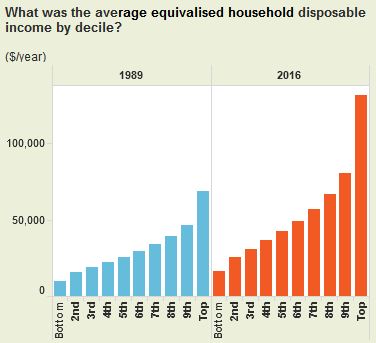
Average equivalised household disposable income in Australia has grown by 2.1% per year (from $30,942 to $53,711) for the last 27 years (1989-16).
This includes a 4 year period of falling incomes (2012-15) following the mining boom.


(Rising inequality? A stocktake of the evidence, Productivity Commission, 2018, p 13)

peaceandlonglife:
Over for the last 27 years, in absolute terms, the incomes of the top 10% have been growing, on average, 7 times faster than those of the bottom 10%.
In percentage terms, the income of the top 10% (2.4%) has been growing 29% faster than the bottom 90% (1.9%).


(Rising inequality? A stocktake of the evidence, Productivity Commission, 2018, p 44)

peaceandlonglife:
In Australia in 1989, the income ratio of the top 10% ($68,495) to the bottom 10% ($9,562) was 7.2 to 1.
By 2016 the income ratio of the top 10% ($131,560) to the bottom 10% ($16,495) had increased to 8.0 to 1.


(Rising inequality? A stocktake of the evidence, Productivity Commission, 2018)


Ratio of average income of the richest 20% to the poorest 20%.
(Richard Wilkinson & Kate Pickett, The Spirit Level, 2009)

Productivity Commission


[In the 2 years to 2014,] the income share held by the top 1% of households rose [by 12.5%:] from 4.8% [to] 5.4% …
Australians aged 25-34 have had declining incomes since 2009-10. …

[In 2015-16, children] under the age of 15 [had] the highest levels of both:
  • income poverty (11.5%, or about 530 000 children), and
  • consumption poverty (12.9%, or a little under 600 000) …
Private consumption poverty has risen in every survey interval since 1993-94. …
[Relative] income poverty [has not declined] despite 27 years of uninterrupted growth …
About half of Australians experienced income poverty at some point between 2001 and 2016. …
About [700,000 Australians] have been in income poverty continuously for at least the last 4 years. …

Among 28 OECD countries [Australia ranks:]
  • 3rd in median household wealth, [but]
  • [8th in equality of] wealth distribution …
[All] wealth deciles except the bottom one saw real increases in average wealth since the early 2000s.
The top half of the wealth distribution experienced particularly strong growth …
[The] wealth of the top decile increased by about $620,000 to reach $2.2 million, which is … about 7 times as much as the median person.
[By contrast, the] average wealth of the bottom decile actually fell … from about $10,000 to $8,000. …

Wealth inequality [in Australia] increased over the [12 years to 2015‑16] by 7%. …
The Gini coefficient for wealth (at about 0.6) is close to double the Gini coefficient for income (at about 0.3) …
[A] person at the 90th percentile of the wealth distribution has almost 40 times as much wealth as [a] person at the 10th percentile; for income, they have 4 times as much. …

[There] is less wealth mobility than income mobility, and more ‘stickiness’ at the top and bottom of the wealth distribution. …
If a father’s lifetime earnings are 10% above average for his generation, we would expect his son’s lifetime earnings to be 2–4% above average for his generation.
[Intergenerational earnings elasticity: 0.22 to 0.41]
peaceandlonglife:
An intergenerational earnings elasticity of 0.3 with a paternal income ratio of 8:1, confers an 87% income advantage to the sons of the richest 10% over the sons of the poorest 10%.
(Rising inequality? A stocktake of the evidence, August 2018)


(M Corak, Income inequality, equality of opportunity, and intergenerational mobility,
Journal of Economic Perspectives, 27:3, pp 79–102, 2013)